


A practical 10-question checklist to review before December 7 so you don’t overpay or lose coverage you need in the new plan year.
By the SeniorAffair.com Medicare Team · Reviewed for accuracy against CMS.gov and Medicare.gov
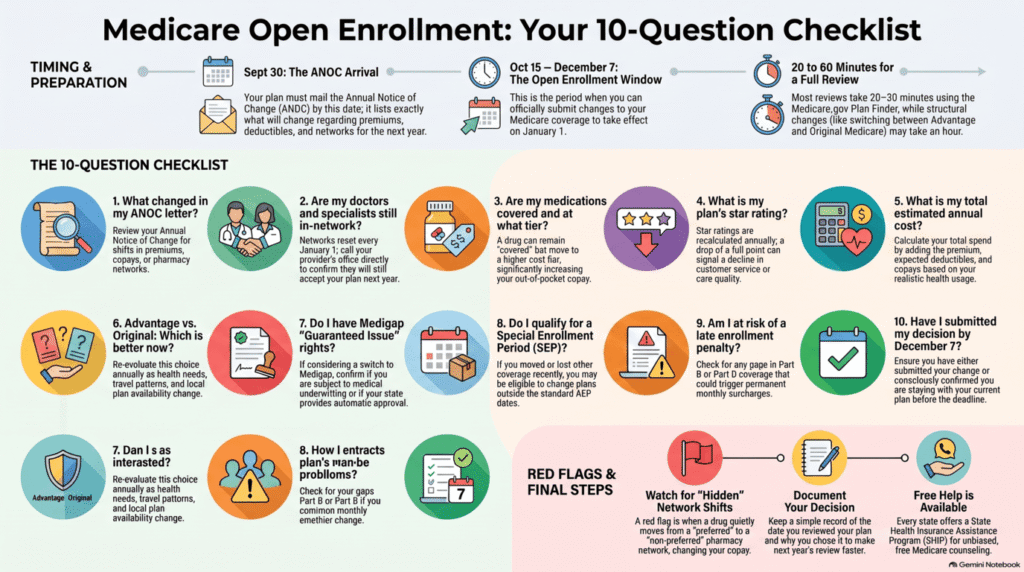
You don’t need hours to do a thorough Medicare Open Enrollment review—you need the right ten questions. Work through this list before December 7, 2026, and you’ll catch the vast majority of changes that actually affect your costs and coverage next year.
Article Contents
1. What changed in my plan’s Annual Notice of Change (ANOC) letter?
Your plan is required to mail this by September 30, and it lists exactly what’s different for next year—premium, deductible, copay changes, and any network or formulary updates. If you can’t find it, call your plan directly or check your plan’s member portal.
2. Are all my doctors and specialists still in-network?
Don’t rely on last year’s card. Networks reset every January 1. Call each provider’s office directly, or check the plan’s current directory, since plan-published directories aren’t always accurate in real time.
3. Are all my medications still covered, and at what tier?
A drug can stay “covered” while moving to a more expensive tier, dramatically changing your copay. Run your exact medication list, dosages included, through Medicare.gov’s Plan Finder. See Medicare Part D Open Enrollment: Comparing Drug Plans for a full breakdown of how tiers work.
4. What is my plan’s star rating this year?
Ratings are recalculated annually and can shift. A plan that was 4 stars last year might be 3 this year, or vice versa. See Medicare Advantage Star Ratings Explained for how to read the rating and where to find it.
5. What is my total estimated annual cost, not just my premium?
Add premium, expected deductible spending, and expected copay/coinsurance based on realistic usage. A $0-premium plan can cost more overall than a plan with a modest monthly premium once actual usage is factored in. See Medicare Costs in 2027: Premiums, Deductibles, and Limits for a full cost breakdown by Medicare part.
Working through this checklist? Pull up plans in your ZIP code now so you can compare as you go.
6. Would I be better off switching between Medicare Advantage and Original Medicare?
This is worth revisiting every year, not just at 65. Health changes, travel patterns, and available local plans all shift the calculation. See Medicare Advantage vs. Original Medicare: How to Decide for the Full Comparison.
7. If I’m considering Medigap, do I still have guaranteed issue rights?
Outside your initial Medigap Open Enrollment window, insurers in most states can medically underwrite a new Medigap application. If you’re weighing a switch, confirm your state’s specific rules before assuming approval is automatic. See Medigap vs. Medicare Advantage: Which Costs Less?.
8. Do I qualify for a Special Enrollment Period instead of waiting for AEP?
If you’ve moved, lost other coverage, or had another qualifying life event this year, you may not need to wait for AEP at all — and you may be well past a SEP deadline you didn’t know existed. See Medicare Special Enrollment Periods: Do You Qualify? for the full list of qualifying events.
9. Am I at risk of a late enrollment penalty I don’t know about?
If you’ve had any gap in Part B or Part D (or creditable equivalent) coverage, check whether a penalty applies or could apply going forward. See Medicare Open Enrollment Deadlines and Penalties for how both penalties are calculated and how to avoid them.
10. Have I submitted my change—or confirmed I’m staying put—before December 7?
Whether you’re switching plans or deliberately staying with your current one, make sure you’ve either submitted your change or consciously decided to do nothing, rather than letting the deadline pass by default. If you are switching, follow the process in How to Switch Medicare Advantage Plans During Open Enrollment.
Ready to finalize your decision? Compare your shortlist side by side before you submit your change.
Printable Summary Checklist
- Read my ANOC letter for next year’s changes
- Confirm my doctors and specialists are still in-network
- Confirm my medications are covered, and check their tier
- Check this year’s star rating for my plan and any alternatives
- Calculate total estimated annual cost, not just premium
- Reconsider Medicare Advantage vs. Original Medicare
- Check my Medigap guaranteed issue status, if relevant
- Check whether a Special Enrollment Period applies to me
- Check for any late enrollment penalty risk
- Submit my change, or confirm I’m intentionally staying, before December 7
How Long Should This Actually Take?
For most people who are staying reasonably close to their current coverage and just double-checking for changes, this review takes about 20–30 minutes using Medicare.gov’s Plan Finder with your medications and doctors pre-loaded. If you’re seriously considering a structural change—switching from Original Medicare to Medicare Advantage, for example, or vice versa—budget closer to an hour, or set aside time with a licensed agent or your state’s SHIP counselor to walk through the tradeoffs in Medicare Advantage vs. Original Medicare: How to Decide and Medigap vs. Medicare Advantage: Which Costs Less? together.
When to Start
Your ANOC letter arrives by September 30, and AEP itself opens October 15. Starting your review as soon as the ANOC letter arrives — rather than waiting for October 15 — gives you a two-week head start before the Plan Finder tool and 1-800-MEDICARE call lines get busier heading into the final weeks of the window.
What to Do If You’re Reviewing for a Parent or Spouse
Bring their Medicare number, a current medication list with dosages, and their provider list to the review. Because enrollment changes generally require the beneficiary’s own consent (or a documented authorized representative on file), plan to do this checklist together rather than making the decision and presenting it as final. Many family members find it easiest to walk through questions 1–5 together in one sitting, then take a day to think over questions 6–7 before finalizing anything.
Red Flags Worth Double-Checking
- A “no change” ANOC letter for a plan that had major issues last year. Absence of a stated change doesn’t always mean nothing shifted—it’s still worth a quick Plan Finder comparison.
- A significant premium jump with no clear explanation. This is often tied to regional cost trends, but it’s worth confirming rather than assuming, especially if similar plans in your area didn’t see the same increase.
- A drug that quietly moved from a preferred to non-preferred pharmacy network. This changes your copay even if the drug itself stayed on the same formulary tier.
- A star rating drop of a full point or more. This can signal a meaningful decline in customer service or care coordination quality, even if costs look similar on paper.
After You’ve Made Your Decision
Once you’ve submitted a change or confirmed you’re intentionally staying with your current plan, keep a simple record: the date you reviewed, what you decided, and why. This takes two minutes and makes next year’s review faster, since you’ll have your own reasoning on hand instead of trying to reconstruct it from memory. If you switched plans, confirm your new member ID card arrives before January 1, and keep your old plan’s information on file in case any claims from December need to be resolved under the old coverage.
A Note on Avoiding Decision Fatigue
With dozens of Medicare Advantage and Part D plans often available in a single county, it’s easy to get overwhelmed and either freeze on a decision or grab the first plan that looks reasonable. Working through this checklist in order—rather than jumping straight to browsing plan options—is designed to narrow the field before you start comparing, so you’re evaluating three or four genuinely relevant plans instead of trying to mentally process dozens of options at once. If you still feel stuck after working through all ten questions, that’s a reasonable point to bring your notes to a licensed agent or your state’s SHIP counselor rather than trying to resolve the last few details alone.
Putting It All Together
This checklist ties directly back to the deeper guides in this series: the full mechanics of the enrollment window in our main Open Enrollment guide, the cost tradeoffs in Medicare Costs in 2027: Premiums, Deductibles, and Limits, and the plan-switching mechanics in How to Switch Medicare Advantage Plans During Open Enrollment. Used together, they cover the entire decision from start to finish—you don’t need to research Medicare from scratch every fall; just work through these ten questions with this year’s numbers.
Set a Reminder for Next Year
Since AEP runs the same seven-week window every fall, it’s worth setting a calendar reminder for late September to check for your ANOC letter, rather than relying on memory or a plan’s marketing mailer to prompt the review. A five-minute habit each September, built around this same checklist, is enough to keep pace with the annual changes that quietly reshape Medicare coverage every January 1.
Frequently Asked Questions
How long does a Medicare Open Enrollment review typically take?
For most people confirming their current plan still fits, the review takes about 20-30 minutes using Medicare.gov’s Plan Finder. Considering a bigger structural change, like switching between Medicare Advantage and Original Medicare, often takes closer to an hour.
What documents do I need before starting my Open Enrollment review?
Your Medicare number, a list of current medications with exact dosages, and a list of the doctors and specialists you see regularly. Your plan’s Annual Notice of Change letter is also useful if you have it.
Do I need to do anything if I’m happy with my current Medicare plan?
Not necessarily, but it’s still worth confirming your doctors and medications are still covered next year, since plan networks and formularies reset every January 1 even if your plan name and premium stay the same.
What’s the single most important thing to check during Open Enrollment?
Confirming your medications are still covered, and at what cost tier, tends to catch the most significant year-over-year cost changes, followed closely by confirming your regular doctors are still in-network.
Can I get free help completing this checklist?
Yes. Every state has a free State Health Insurance Assistance Program (SHIP) that offers unbiased Medicare counseling at no cost, in addition to 1-800-MEDICARE and licensed insura
More in This Medicare Open Enrollment Guide
- Medicare Open Enrollment 2027: The Complete Guide
- Medicare Advantage vs. Original Medicare: How to Decide
- How to Switch Medicare Advantage Plans During Open Enrollment
- Medicare Part D Open Enrollment: Comparing Drug Plans
- Medigap vs. Medicare Advantage: Which Costs Less?
- Medicare Open Enrollment Deadlines and Penalties
- Medicare Advantage Star Ratings Explained
- Medicare Special Enrollment Periods: Do You Qualify?
- Medicare Costs in 2027: Premiums, Deductibles, and Limits
- Medicare Open Enrollment Checklist: 10 Questions to Ask
Not sure your current plan is still your best option?
Compare Medicare Advantage, Part D, and Medigap plans available in your ZIP code before the December 7 deadline.
SeniorAffair.com may earn a commission from partner links above. This does not affect our editorial coverage. We are not connected with or endorsed by the U.S. government or the federal Medicare program.
© 2026 SeniorAffair.com — A 55+ Lifestyle Digital Magazine. Information on this page is general in nature and not a substitute for personalized advice from Medicare.gov, 1-800-MEDICARE, or a licensed insurance agent.