


A side-by-side comparison of Medicare Advantage and Original Medicare covering costs, networks, and extra benefits to help you choose during Open Enrollment.
By the SeniorAffair.com Medicare Team · Reviewed for accuracy against CMS.gov and Medicare.gov
Every fall, the biggest decision Medicare beneficiaries face isn’t which specific plan to pick—it’s the more fundamental choice between Medicare Advantage and Original Medicare. Both are legitimate ways to get your Medicare benefits, but they work so differently that the “right” answer depends heavily on your health, budget, and travel habits. This guide breaks down the real tradeoffs so you can decide before the December 7 Open Enrollment deadline.
Article Contents
The Basic Structural Difference
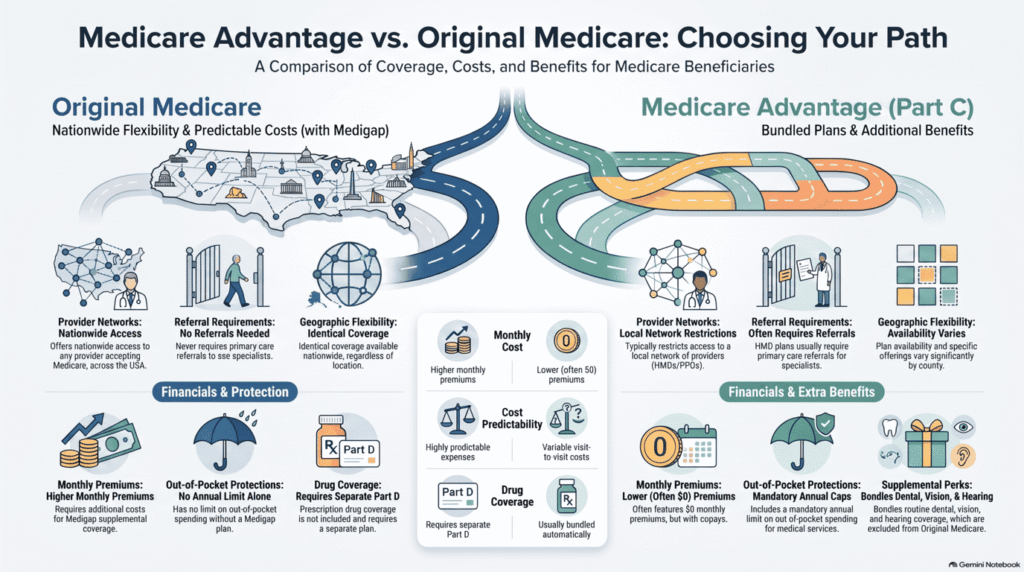
Original Medicare is the traditional government-run program: Part A covers hospital stays, Part B covers doctor visits and outpatient care, and you can add a standalone Part D plan for prescriptions and a Medigap policy to cover the gaps. You can see any doctor or hospital in the country that accepts Medicare—no referrals, no network.
Medicare Advantage (Part C) is an alternative way to get your Part A and Part B benefits through a private insurance company approved by Medicare. Most Medicare Advantage plans bundle in Part D drug coverage and add extra benefits like dental, vision, hearing, and fitness programs—but they usually require you to use an in-network provider (HMO) or pay more to go out-of-network (PPO).
Cost Comparison
| Cost Factor | Original Medicare + Medigap + Part D | Medicare Advantage |
|---|---|---|
| Monthly premium | Part B premium + Medigap premium (often $100–$300+) + Part D premium | Often $0, plus the standard Part B premium |
| Out-of-pocket maximum | None on Original Medicare alone; Medigap caps most out-of-pocket costs | Federally required annual out-of-pocket max (varies by plan, often $4,000–$8,850) |
| Predictability | Very predictable with Medigap; you rarely see a surprise bill | Lower monthly cost, but costs vary more visit-to-visit |
| Extra benefits (dental, vision, hearing) | Not included; must be purchased separately | Frequently included as supplemental benefits |
For a deeper cost walkthrough with current 2026 figures, see Medicare Costs in 2027: Premiums, Deductibles, and Limits.
Wondering which plan type fits your budget best? Compare Medicare Advantage and Medigap costs side by side in your area.
Provider Networks and Referrals
This is the single biggest practical difference. With Original Medicare, you can see any provider nationwide who accepts Medicare, with no referrals for specialists. With Medicare Advantage, you’re generally limited to the plan’s network, and HMO plans typically require a referral from your primary care doctor to see a specialist. If you split time between two states, have a specific specialist you’re loyal to, or travel frequently, network restrictions matter a lot more than the premium difference.
Extra Benefits Medicare Advantage Offers
- Routine dental cleanings, x-rays, and sometimes major dental work
- Eyewear and routine vision exams
- Hearing aids and hearing exams
- Gym memberships or fitness program allowances
- Over-the-counter allowance cards for approved health items
- In some plans, transportation to medical appointments or meal delivery after a hospital stay
Original Medicare doesn’t include any of these. If dental and vision coverage matter to you and you want to stick with Original Medicare, you’d need to purchase separate standalone dental/vision insurance.
Who Original Medicare Tends to Fit Better
- People who travel often or split time between two states
- People with a chronic condition who see multiple specialists and don’t want referral friction
- People who prioritize predictable costs and are willing to pay more monthly for a Medigap policy to avoid it
- People with a specific out-of-network specialist or hospital system they don’t want to give up
Who Medicare Advantage Tends to Fit Better
- People who are generally healthy and want to minimize monthly premiums
- People who want dental, vision, and hearing coverage bundled into one plan
- People comfortable using a defined network of local providers
- People who want prescription drug coverage bundled in automatically
If you’re leaning toward Medicare Advantage, see which plans in your ZIP code include your doctors and dental/vision benefits.
Switching Between Them
You’re not locked in permanently. During Open Enrollment (Oct 15–Dec 7), you can move from Original Medicare to Medicare Advantage or from Medicare Advantage back to Original Medicare. If you’re already in Medicare Advantage and just want to try a different Advantage plan, see the process in How to Switch Medicare Advantage Plans During Open Enrollment. One important note: if you drop a Medigap policy to try Medicare Advantage and later want to switch back, you may face medical underwriting to get Medigap again outside your initial enrollment window—explained in Medigap vs. Medicare Advantage: Which Costs Less?.
How Star Ratings Fit Into This Decision
If you’re leaning toward Medicare Advantage, the plan’s CMS star rating is one of the clearest quality signals available—it reflects member satisfaction, customer service responsiveness, and how well the plan manages chronic conditions. See Medicare Advantage Star Ratings Explained for how to read it before you enroll.
A Practical Way to Decide
- List every doctor and specialist you currently see, and check whether they’re in-network for any Medicare Advantage plans you’re considering.
- Add up your total annual cost estimate for both paths using the Medicare Advantage vs. Original Medicare calculator on Medicare.gov’s Plan Finder.
- Consider how often you travel outside your home state.
- Decide how much you value bundled extra benefits versus network flexibility.
- If still unsure, a licensed agent can run both scenarios side by side using your actual prescriptions and providers.
Two Real-World Scenarios
Scenario A: The Snowbird
Consider someone who spends winters in Florida and summers in Ohio. A Medicare Advantage HMO plan tied to a single-state network would leave them without in-network coverage for half the year, forcing emergency-only care in their second home. Original Medicare, paired with a Medigap policy, follows them anywhere in the country that accepts Medicare, making it the more practical fit even at a higher monthly premium. Some Medicare Advantage PPO plans do offer broader out-of-network coverage, so it’s worth checking whether a PPO option in your area changes this calculation.
Scenario B: The Budget-Conscious, Generally Healthy Retiree
Someone in good health, on no regular prescriptions, who sees a primary care doctor once a year and wants to minimize monthly costs, is often well served by a $0-premium Medicare Advantage plan with dental and vision bundled in. Their annual out-of-pocket exposure is capped, and since they rarely use care beyond routine visits, the network restriction is a minor inconvenience rather than a real limitation.
Most people fall somewhere between these two extremes, which is exactly why running your own numbers—rather than relying on a friend’s experience or a TV ad—matters so much during Open Enrollment.
Regional Availability Varies Widely
Not every Medicare Advantage plan is available everywhere. Insurers build out their networks county by county, so a plan that looks great in a metro area might not exist—or might have a thin network—in a rural county nearby. Original Medicare, by contrast, is available and identical nationwide, since it’s run directly by the federal government rather than licensed state-by-state by private insurers. If you live in a rural area, it’s worth specifically checking how many Medicare Advantage plans are actually offered in your county before assuming you’ll have the same options as someone in a major city.
What If Your Health Needs Change Mid-Year?
Neither Original Medicare nor Medicare Advantage lets you switch outside of Open Enrollment just because a new diagnosis changed your calculus—with one exception. If you’re diagnosed with certain chronic conditions, some insurers offer Chronic Condition Special Needs Plans (C-SNPs); you may become eligible to join outside AEP. Losing employer coverage, moving, or qualifying for Medicaid can also open a Special Enrollment Period regardless of which path you originally chose. See Medicare Special Enrollment Periods: Do You Qualify? for the full list of qualifying events.
Questions Worth Asking Before You Commit
- “Is my primary care doctor and every specialist I see in-network for this specific plan?” Ask the provider’s office directly, since plan directories aren’t always current.
- “What is the plan’s maximum out-of-pocket limit, and does it include drug costs?” Some Medicare Advantage plans cap medical costs but treat Part D spending separately.
- “If I need a Medigap policy later, will I have guaranteed issue rights, or will I face medical underwriting?” This matters most for anyone considering trying Medicare Advantage first with the idea of switching back later.
- “Does this plan require referrals to see specialists, and how long does prior authorization typically take?” This affects how quickly you can actually get care, not just what it costs.
- “What supplemental benefits are included, and are there eligibility restrictions on using them?” Many advertised extras like transportation or OTC allowances have usage limits or specific qualifying criteria buried in the plan’s Evidence of Coverage document.
Bringing this list to a licensed agent or using it while browsing Medicare.gov’s Plan Finder tool turns an abstract decision into a concrete, side-by-side comparison you can actually act on before December 7.
The Bottom Line
There isn’t a universally “better” option between Medicare Advantage and Original Medicare—there’s only a better fit for your specific health, budget, and travel pattern. The mistake most beneficiaries make isn’t picking the wrong path; it’s picking a path once during their Initial Enrollment Period and never revisiting the decision again, even as their health, finances, or the plans available in their area change. Open Enrollment exists precisely so that decision doesn’t have to be permanent.
Frequently Asked Questions
Is Medicare Advantage cheaper than Original Medicare?
Medicare Advantage often has a lower or $0 monthly premium than Original Medicare plus a Medigap policy, but it typically has higher potential out-of-pocket costs when you actually use care, since it relies on copays and coinsurance up to an annual maximum rather than the flatter, more predictable costs Medigap provides.
Can I see any doctor with Medicare Advantage?
Generally no. Most Medicare Advantage plans use a network of doctors and hospitals, and HMO plans usually require referrals to see specialists. Original Medicare lets you see any provider nationwide who accepts Medicare.
Does Medicare Advantage include prescription drug coverage?
Most Medicare Advantage plans bundle in Part D prescription drug coverage automatically (called MAPD plans). Some, particularly certain PPO or private-fee-for-service plans, do not, so it’s worth confirming for any plan you’re considering.
Can I switch from Medicare Advantage back to Original Medicare?
Yes, you can switch back to Original Medicare during the Annual Enrollment Period (Oct 15 – Dec 7) or during the Medicare Advantage Open Enrollment Period (Jan 1 – Mar 31) if you’re already in a Medicare Advantage plan.
Does Original Medicare cover dental and vision?
No. Original Medicare does not cover routine dental, vision, or hearing care. Many Medicare Advantage plans include these as supplemental benefits, or you can purchase standalone dental/vision insurance alongside Original Medicare.
More in This Medicare Open Enrollment Guide
- Medicare Open Enrollment 2027: The Complete Guide
- Medicare Advantage vs. Original Medicare: How to Decide
- How to Switch Medicare Advantage Plans During Open Enrollment
- Medicare Part D Open Enrollment: Comparing Drug Plans
- Medigap vs. Medicare Advantage: Which Costs Less?
- Medicare Open Enrollment Deadlines and Penalties
- Medicare Advantage Star Ratings Explained
- Medicare Special Enrollment Periods: Do You Qualify?
- Medicare Costs in 2027: Premiums, Deductibles, and Limits
- Medicare Open Enrollment Checklist: 10 Questions to Ask
Not sure your current plan is still your best option?
Compare Medicare Advantage, Part D, and Medigap plans available in your ZIP code before the December 7 deadline.
SeniorAffair.com may earn a commission from partner links above. This does not affect our editorial coverage.
We are not connected with or endorsed by the U.S. government or the federal Medicare program.
© 2026 SeniorAffair.com — A 55+ Lifestyle Digital Magazine.
Information on this page is general in nature and not a substitute for personalized advice from Medicare.gov, 1-800-MEDICARE, or a licensed insurance agent.





[…] a detailed comparison of the Advantage vs. Original decision, see Medicare Advantage vs. Original Medicare: How to Decide. If you already know you want to switch Medicare Advantage plans, the step-by-step process is […]