


Step-by-step instructions for switching Medicare Advantage plans during the Annual Enrollment Period, including deadlines, documents, and common mistakes.
By the SeniorAffair.com Medicare Team · Reviewed for accuracy against CMS.gov and Medicare.gov
Switching Medicare Advantage plans is more straightforward than most people expect—there’s no application to be denied, no medical questionnaire, and no waiting period. If you’re enrolled in a Medicare Advantage plan and want a different one for 2027, here’s exactly how the process works during Open Enrollment (Oct 15–Dec 7, 2026).
Article Contents
Common Reasons People Switch Medicare Advantage Plans
- Their doctor or preferred hospital left the plan’s network
- A prescription moved to a higher (more expensive) drug tier or was dropped from the formulary
- The premium, deductible, or copays increased in the plan’s Annual Notice of Change letter
- The plan’s star rating dropped, signaling declining customer service or care quality
- They moved to a new county or state where the plan isn’t offered, or a better plan became available
- They want additional supplemental benefits, like dental or transportation, not offered in their current plan
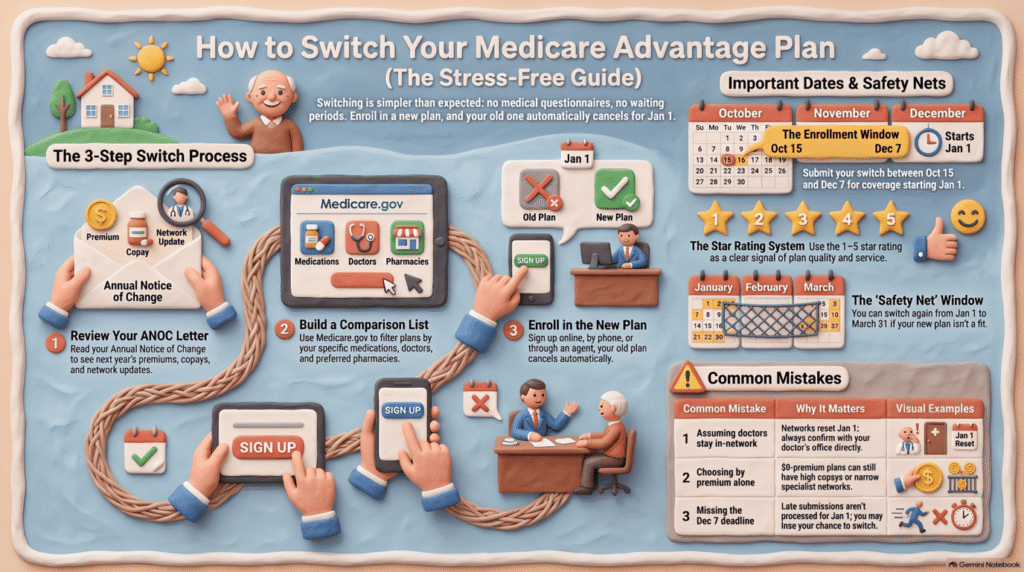
Step 1: Confirm What’s Changing in Your Current Plan
Start with your Annual Notice of Change (ANOC) letter, mailed by your plan by September 30. It spells out next year’s premium, deductible, copays, and any changes to the provider network or drug formulary. This is the document that tells you whether switching is worth the effort at all—sometimes a plan’s changes are minor, and staying put is the simplest choice.
Step 2: Build Your Comparison List
Before comparing plans, gather:
- Your current prescriptions, with exact dosages
- A list of the doctors, specialists, and hospitals you use regularly
- Your preferred pharmacy
- An honest estimate of how often you expect to need care next year
Then use Medicare.gov’s Plan Finder tool (or a licensed agent) to see every Medicare Advantage plan available in your ZIP code, filtered by your medications and providers. Pay attention to the plan’s star rating, since it’s one of the clearest available signals of plan quality.
Step 3: Enroll in the New Plan
This is the part that surprises people: you do not need to cancel your old plan first. When you enroll in a new Medicare Advantage plan, it automatically cancels your enrollment in the old one, effective the same date the new plan starts. You can enroll:
- Online at Medicare.gov using your Medicare number
- By phone by calling 1-800-MEDICARE (available 24/7)
- Directly through the new plan’s website or a licensed agent who can submit the enrollment on your behalf
- By mail using a paper enrollment form from the new plan
Ready to compare alternatives before you commit to a switch? See every Medicare Advantage plan available in your ZIP code.
Step 4: Confirm Your Effective Date
Any switch made during AEP (Oct 15–Dec 7) takes effect January 1, 2027, regardless of the exact date you submitted it within that window. You should receive a confirmation letter and a new member ID card from the new plan before the end of December. If you haven’t received your card by early January, call the new plan directly to confirm your enrollment went through.
What Happens to Your Old Plan
Your old Medicare Advantage plan coverage ends automatically on December 31, and your new plan’s coverage begins January 1. You do not need to send a cancellation notice to your old plan—the enrollment system handles it for you once the new plan processes your application. One exception: if you’re switching for reasons related to unpaid premiums or a plan-initiated disenrollment, contact the plan directly, since that process works differently.
Common Mistakes When Switching
| Mistake | Why It Matters |
|---|---|
| Assuming your doctor is in-network based on last year’s card | Networks reset every January 1; confirm directly with the provider’s office for the new plan year |
| Switching based on premium alone | A $0-premium plan can still have high copays, prior authorization requirements, or a narrow specialist network |
| Enrolling twice in different plans | The most recent enrollment submitted before Dec 7 is the one that takes effect—double-enrolling can create confusion, not extra coverage |
| Missing the Dec 7 deadline by a few days | Late submissions aren’t processed for a Jan 1 effective date; you may have to wait for the Medicare Advantage Open Enrollment Period in January–March instead |
| Not checking the drug formulary tier-by-tier | A drug can be “covered” but placed in a high-cost tier, dramatically changing your actual copay |
For a full rundown of what happens after a missed deadline, see Medicare Open Enrollment Deadlines and Penalties.
Switching to Original Medicare Instead
If you decide you’d rather leave Medicare Advantage altogether and return to Original Medicare, the same enrollment window applies. You’ll want to also enroll in a standalone Part D plan (see Medicare Part D Open Enrollment: Comparing Drug Plans) and consider whether you can add a Medigap policy, since your guaranteed issue rights for Medigap outside your initial enrollment window vary by state—covered in Medigap vs. Medicare Advantage: Which Costs Less?.
What If You Want to Switch Again in Early 2027?
If your new plan turns out not to be a good fit once you start using it, you’re not completely stuck until next fall. The Medicare Advantage Open Enrollment Period runs January 1–March 31 and allows one additional switch to a different Medicare Advantage plan or a return to Original Medicare with a Part D plan. It’s a narrower window than AEP—you can’t switch standalone Part D plans without also being in Medicare Advantage—but it exists as a safety net for exactly this situation.
A Simple Pre-Enrollment Checklist
- Read your ANOC letter for next year’s changes
- List your medications, doctors, and pharmacy
- Compare at least 2–3 plans on Medicare.gov’s Plan Finder
- Check each plan’s star rating
- Confirm total estimated annual cost, not just premium
- Enroll online, by phone, or through an agent before December 7
- Confirm your new member ID card arrives before January 1
Want a shortlist before you call an agent? Filter Medicare Advantage plans by your prescriptions and doctors in minutes.
Working With a Licensed Agent vs. Doing It Yourself
Both paths work, and neither costs you extra—licensed agents are paid by the insurance carrier, not by you, so using one doesn’t raise your premium. A licensed independent agent who represents multiple carriers can run side-by-side comparisons faster than browsing Medicare.gov alone and can flag network or formulary issues you might miss. The tradeoff is that an agent tied to a single carrier will only show you that company’s plans, so it’s worth asking upfront whether the agent is independent or captive to one insurer. If you’d rather compare on your own first and bring questions to an agent afterward, that’s a perfectly reasonable approach too—Medicare.gov’s Plan Finder tool is built for public, self-service use.
Switching for a Specific Reason: Three Scenarios
“My doctor left the network”
Search Plan Finder using your specialist’s name directly, not just general network descriptions, since some plans include a specialist for certain procedures but not others. If the same doctor is in-network for multiple plans, compare those plans’ drug formularies and copay structures to narrow down the choice.
“My premium and copays went up in the ANOC letter”
Compare the new total annual cost estimate (premium plus expected copays based on last year’s usage) against at least two alternative plans in your area. Sometimes the increase is roughly matched across most local plans because it reflects a regional cost trend rather than something specific to your plan—worth confirming before assuming a switch will save money.
“I want dental or vision coverage I don’t currently have”
Not all supplemental benefits are equal. Compare the actual dollar allowance and annual maximum for dental work, not just whether a plan advertises “dental coverage included.” Some plans cap preventive cleanings at two per year with no coverage for major work like crowns or root canals, while others include a meaningful allowance toward major procedures.
How Plan Finder Displays Your Options
When you search Medicare.gov’s Plan Finder with your medications and providers entered, it returns a ranked list showing each plan’s estimated total annual cost, monthly premium, deductible, and whether your specific doctors and drugs are covered. It also displays each plan’s star rating and a direct link to the plan’s Evidence of Coverage document, which is the legally binding description of exactly what’s covered. Reading at least the summary of benefits section of the Evidence of Coverage—not just the marketing brochure—is the single best way to avoid a mid-year coverage surprise.
After You Enroll: What to Expect Next
Once your enrollment is processed, you’ll typically receive a confirmation letter within a couple of weeks, followed by your new member ID card closer to the January 1 effective date. Keep both your old and new ID cards through the transition—you may need your old plan’s information for any claims from care received before December 31. If you don’t receive confirmation within a few weeks of enrolling, don’t assume it went through silently; call the new plan directly or 1-800-MEDICARE to verify your application was received and processed correctly before the deadline passes.
Frequently Asked Questions
Do I need to cancel my old Medicare Advantage plan before switching?
No. Enrolling in a new Medicare Advantage plan automatically cancels your enrollment in the old one, effective the date the new plan’s coverage begins.
How long does it take for a Medicare Advantage plan switch to take effect?
Switches made during the Annual Enrollment Period (Oct 15 – Dec 7) all take effect on January 1 of the following year, regardless of when during that window you submit the change.
Can I switch Medicare Advantage plans more than once a year?
You can switch during the Annual Enrollment Period (Oct 15 – Dec 7), and if you’re already in a Medicare Advantage plan, you get one additional switch during the Medicare Advantage Open Enrollment Period (Jan 1 – Mar 31).
What documents do I need to switch Medicare Advantage plans?
You’ll need your Medicare number, a list of your current prescriptions with dosages, and the names of the doctors and hospitals you use. No medical questionnaire or health screening is required to switch Medicare Advantage plans.
What happens if I miss the December 7 deadline?
If you miss the deadline and you’re already in Medicare Advantage, you can still make one change during the Medicare Advantage Open Enrollment Period from January 1 to March 31. Otherwise you may need to qualify for a Special Enrollment Period or wait until the next Annual Enrollment Period.
More in This Medicare Open Enrollment Guide
- Medicare Open Enrollment 2027: The Complete Guide
- Medicare Advantage vs. Original Medicare: How to Decide
- How to Switch Medicare Advantage Plans During Open Enrollment
- Medicare Part D Open Enrollment: Comparing Drug Plans
- Medigap vs. Medicare Advantage: Which Costs Less?
- Medicare Open Enrollment Deadlines and Penalties
- Medicare Advantage Star Ratings Explained
- Medicare Special Enrollment Periods: Do You Qualify?
- Medicare Costs in 2027: Premiums, Deductibles, and Limits
- Medicare Open Enrollment Checklist: 10 Questions to Ask
Not sure your current plan is still your best option?
Compare Medicare Advantage, Part D, and Medigap plans available in your ZIP code before the December 7 deadline.
SeniorAffair.com may earn a commission from partner links above. This does not affect our editorial coverage.
We are not connected with or endorsed by the U.S. government or the federal Medicare program.
© 2026 SeniorAffair.com—A 55+ Lifestyle Digital Magazine. Information on this page is general in nature and not a substitute for personalized advice from Medicare.gov, 1-800-MEDICARE, or a licensed insurance agent.