


A breakdown of Medicare Part A, Part B, Part D, Medigap, and Medicare Advantage costs—what’s confirmed for 2026 and what to watch for in 2027.
By the SeniorAffair.com Medicare Team · Reviewed for accuracy against CMS.gov and Medicare.gov
Medicare costs are made up of several separate pieces—Part A, Part B, Part D, and, depending on your path, either Medigap or Medicare Advantage cost-sharing. Here’s a breakdown of confirmed 2026 figures, what typically changes each fall, and what to watch for as CMS finalizes 2027 numbers ahead of Open Enrollment.
Article Contents
A note on timing: CMS typically announces final Part A, Part B, and Part D figures for the coming plan year in the fall, close to the start of the Annual Enrollment Period. The figures below reflect confirmed 2026 amounts; check back here or Medicare.gov directly once CMS finalizes 2027 numbers.
Part A Costs
| Cost | 2026 Amount |
|---|---|
| Monthly premium | $0 for most people who paid Medicare taxes for at least 10 years; otherwise, up to several hundred dollars per month |
| Inpatient hospital deductible (per benefit period) | Set annually by CMS; generally increases modestly each year |
| Skilled nursing facility coinsurance (days 21–100) | A set daily coinsurance amount, adjusted annually |
Most beneficiaries qualify for premium-free Part A based on their own or a spouse’s work history, making Part B and Part D premiums the more consistently relevant costs to plan around.
Part B Costs
| Cost | 2026 Amount |
|---|---|
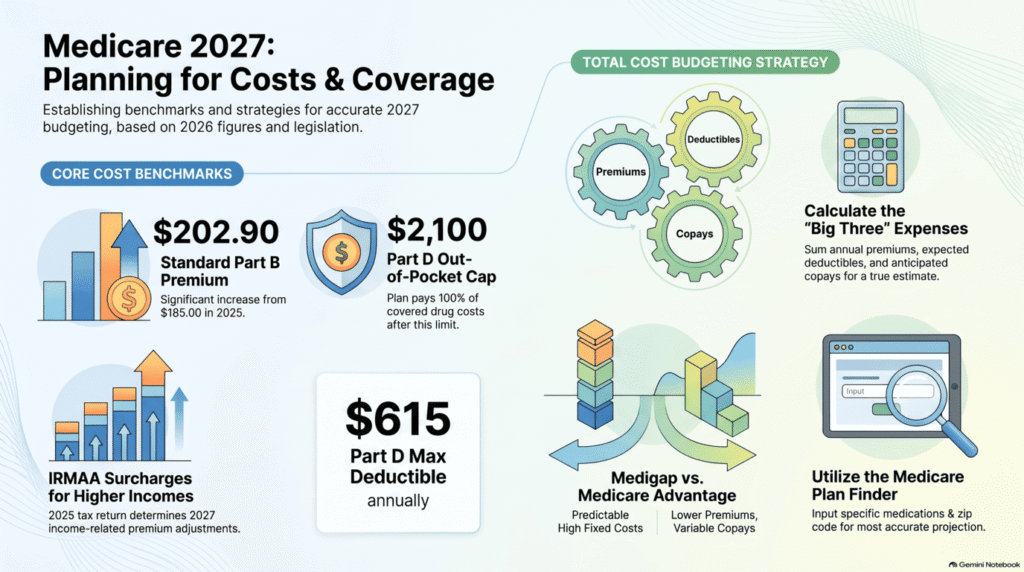
| Standard monthly premium | $202.90, up from $185.00 in 2025 |
| Annual deductible | Set annually by CMS |
| Coinsurance after deductible | Generally 20% of the Medicare-approved amount for most services |
Income-Related Monthly Adjustment Amount (IRMAA)
Higher-income beneficiaries pay more than the standard Part B and Part D premiums. IRMAA is based on your modified adjusted gross income from two years prior (your 2025 tax return determines your 2027 IRMAA bracket) and is recalculated annually as income thresholds adjust. If your income has dropped since that reference year—due to retirement, a life-changing event, or other circumstances—you can request a reconsideration with Social Security using Form SSA-44 rather than paying the higher amount automatically.
Curious what you’d actually pay under a specific plan? Get a personalized total cost estimate for your ZIP code.
Part D Costs
| Cost | 2026 Amount |
|---|---|
| Maximum annual deductible | $615 (many plans set a lower or $0 deductible) |
| Out-of-pocket cap (catastrophic threshold) | $2,100 |
| Premium | Varies significantly by plan; averages have trended down slightly in recent years as competition among plans increased |
See Medicare Part D Open Enrollment: Comparing Drug Plans for how the three-phase Part D cost structure works and how to compare plan-specific pricing.
Medicare Advantage Costs
| Cost | Typical 2026 Range |
|---|---|
| Monthly premium | Often $0, though some plans charge a premium in exchange for richer benefits |
| Annual out-of-pocket maximum (in-network) | Federally capped, commonly in the $4,000–$8,850 range depending on the plan |
| Copays and coinsurance | Vary by plan and service — primary care, specialist, hospital, and drug copays are all set individually by the plan |
You still pay the standard Part B premium (or your IRMAA-adjusted amount) even while enrolled in Medicare Advantage, since Part C is built on top of your existing Part A and B eligibility.
Medigap Costs
| Cost | Typical Range |
|---|---|
| Monthly premium | Commonly $100–$300+ depending on plan letter, state, insurer, and your age at enrollment |
| Out-of-pocket costs for covered services | Minimal to none with a comprehensive plan letter like Plan G |
Medigap pricing methods vary by state—some insurers use “attained-age” pricing (premiums increase as you get older), others use “issue-age” pricing (premiums are based on your age when you first bought the policy and don’t increase due to age alone), and others use “community-rated” pricing (everyone in an area pays the same premium regardless of age). This distinction can meaningfully affect your long-term costs, so it’s worth asking an insurer directly which pricing method applies. See Medigap vs. Medicare Advantage: Which Costs Less? for the full cost tradeoff between Medigap and Medicare Advantage.
What Tends to Change Each Year
- The standard Part B premium and deductible—adjusted annually based on program costs
- The Part D out-of-pocket cap—indexed to Part D spending growth under the Inflation Reduction Act
- IRMAA income thresholds—adjusted for inflation
- Individual Medicare Advantage and Part D plan premiums, deductibles, and copays—set independently by each insurer
- Medicare Advantage plan availability—insurers can enter or exit specific counties from year to year
Skip the manual math. Compare estimated annual costs across plans automatically.
Estimating Your Total Annual Cost
The single biggest budgeting mistake is comparing plans by premium alone. A complete estimate should include:
- Monthly premiums (Part B, plus Part D or Medigap, plus any Medicare Advantage premium) × 12
- Expected deductible spending based on your typical annual usage
- Expected copay or coinsurance spending for routine visits, specialist visits, and any planned procedures
- A buffer for unplanned care, capped at the plan’s annual out-of-pocket maximum if you have Medicare Advantage
Medicare.gov’s Plan Finder tool calculates this automatically once you enter your medications and expected usage, which is why it’s worth using directly rather than estimating by hand.
Where to Find the Final 2027 Numbers
CMS typically releases final Part A, Part B, and Part D cost figures for the upcoming plan year in the fall, ahead of the October 15 start of Open Enrollment. Once released, updated numbers are reflected on Medicare.gov and in each plan’s Annual Notice of Change letter, mailed by September 30. Check our main Open Enrollment guide for the latest confirmed figures as they’re announced.
Programs That Can Lower Your Costs
Several assistance programs can reduce Medicare costs for beneficiaries with limited income and resources, and none of them are tied to the Open Enrollment calendar—you can apply any time of year:
- Extra Help (Low-Income Subsidy): reduces or eliminates Part D premiums, deductibles, and copays for qualifying beneficiaries. Applied for through the Social Security Administration.
- Medicare Savings Programs: state-administered programs that can help pay Part B premiums and, in some cases Part A and B deductibles, copays, and coinsurance for beneficiaries who meet income and asset limits.
- Medicaid dual eligibility: beneficiaries who qualify for both Medicare and Medicaid often have most of their out-of-pocket Medicare costs are covered by Medicaid, and you typically gain access to a monthly Special Enrollment Period as well—see Medicare Special Enrollment Periods: Do You Qualify?.
If your income is close to any of these program thresholds, it’s worth checking eligibility even if you don’t think you’ll qualify—the income and asset limits are often higher than people assume, and state Medicare Savings Program limits can differ from the federal Extra Help thresholds.
A Worked Cost Comparison
Consider a hypothetical beneficiary paying the standard 2026 Part B premium of $202.90/month ($2,434.80/year), a $35/month Part D plan ($420/year) with $400 in annual drug copays, and occasional specialist visits. Under Original Medicare alone (no Medigap), unpredictable 20% coinsurance on specialist and outpatient costs could add anywhere from a few hundred to several thousand dollars depending on the year. Adding a Medigap Plan G at roughly $150/month ($1,800/year) would push total fixed costs higher but cap nearly all of that coinsurance exposure. A $0-premium Medicare Advantage plan, by contrast, would eliminate the Medigap line entirely but introduce per-visit copays and coinsurance up to the plan’s annual out-of-pocket maximum. Running this kind of side-by-side estimate with your own real numbers—rather than a hypothetical—is exactly what Medicare.gov’s Plan Finder tool is built to do.
Costs That Are Easy to Overlook
- Out-of-network costs under Medicare Advantage HMO plans, which can mean paying the full cost of a service if you see a provider outside the network without authorization
- Specialty drug coinsurance before you reach the Part D catastrophic phase, which can be a meaningful percentage of a high-cost medication’s price
- Skilled nursing facility coinsurance for stays beyond 20 days, which applies under both Original Medicare and Medicare Advantage plans, though the exact daily amount can differ
- Dental and vision costs under Original Medicare, since routine care in these categories isn’t covered at all without a separate supplemental policy
Building Your Own Annual Cost Estimate
Rather than relying on national averages, the most reliable estimate uses your actual medications, your actual providers, and your realistic usage pattern from the past year or two as a guide. Someone who visited a specialist four times last year should assume something similar next year unless a health change suggests otherwise, and someone who filled the same three prescriptions monthly for years should carry that forward too. Once you’ve compared that realistic estimate across two or three plans using the Open Enrollment checklist, you’ll have a far more accurate picture than any generic “average Medicare beneficiary spends $X” statistic could give you.
Bottom Line
Medicare’s cost structure has several moving parts, but the core levers are the same every year: your Part B premium (and possible IRMAA surcharge), your choice between Medigap-covered predictability and Medicare Advantage-style variable cost-sharing and your Part D drug plan’s specific formulary and deductible. Reviewing all three together during Open Enrollment, rather than in isolation, is what actually catches the overpayment most beneficiaries never notice.
Frequently Asked Questions
What is the standard Medicare Part B premium for 2026?
The standard Part B premium for 2026 is $202.90 per month, up from $185.00 in 2025. Higher-income beneficiaries pay more through the Income-Related Monthly Adjustment Amount (IRMAA).
What is the Medicare Part D out-of-pocket cap for 2026?
The 2026 Part D out-of-pocket cap is $2,100. Once your covered drug spending reaches that amount, your plan pays 100% of covered drug costs for the rest of the calendar year.
Do I have to pay a premium for Medicare Part A?
Most people qualify for premium-free Part A based on at least 10 years of Medicare-taxed work history, either their own or a spouse’s. Those who don’t qualify pay a monthly premium that can be several hundred dollars.
What is IRMAA and how is it calculated?
IRMAA (Income-Related Monthly Adjustment Amount) is an additional premium higher-income beneficiaries pay on top of the standard Part B and Part D premiums, based on modified adjusted gross income from two years prior.
When does CMS announce final Medicare costs for the next year?
CMS typically announces final Part A, Part B, and Part D cost figures for the upcoming plan year in the fall, shortly before the October 15 start of the Annual Enrollment Period.
More in This Medicare Open Enrollment Guide
- Medicare Open Enrollment 2027: The Complete Guide
- Medicare Advantage vs. Original Medicare: How to Decide
- How to Switch Medicare Advantage Plans During Open Enrollment
- Medicare Part D Open Enrollment: Comparing Drug Plans
- Medigap vs. Medicare Advantage: Which Costs Less?
- Medicare Open Enrollment Deadlines and Penalties
- Medicare Advantage Star Ratings Explained
- Medicare Special Enrollment Periods: Do You Qualify?
- Medicare Costs in 2027: Premiums, Deductibles, and Limits
- Medicare Open Enrollment Checklist: 10 Questions to Ask
Not sure your current plan is still your best option?
Compare Medicare Advantage, Part D, and Medigap plans available in your ZIP code before the December 7 deadline.
SeniorAffair.com may earn a commission from partner links above. This does not affect our editorial coverage.
We are not connected with or endorsed by the U.S. government or the federal Medicare program.
© 2026 SeniorAffair.com — A 55+ Lifestyle Digital Magazine.
Information on this page is general in nature and not a substitute for personalized advice from Medicare.gov, 1-800-MEDICARE, or a licensed insurance agent.