


A guide to Medicare Special Enrollment Periods (SEPs)—the life events that let you change coverage outside the Annual Enrollment Period.
By the SeniorAffair.com Medicare Team · Reviewed for accuracy against CMS.gov and Medicare.gov
Open Enrollment (Oct 15–Dec 7) isn’t the only time you can change Medicare coverage. If a specific life event happens to you, a Special Enrollment Period (SEP) can open a window to make changes outside the normal fall schedule — sometimes for 60 days, sometimes longer, depending on the trigger.
Article Contents
What Counts as a Qualifying Event
SEPs exist because Medicare recognizes that life doesn’t wait for October. Below are the most common triggers.
Moving
| Situation | SEP Window |
|---|---|
| You move outside your current plan’s service area | Generally starts the month before you move and continues for 2 full months after |
| You move, and new plan options become available in your new area | Same window as above—you can choose a new Medicare Advantage or Part D plan |
| You move back to the U.S. after living abroad | 2 full months from the month you move back |
Losing Other Coverage
- Losing employer or union coverage: a SEP typically applies for 2 months after the coverage ends, allowing you to enroll in Part B (if you haven’t already) and Part D without penalty.
- Losing Medicaid eligibility: a SEP applies to help you transition to other Medicare coverage.
- Your Medicare Advantage or Part D plan leaves Medicare or stops serving your area: CMS grants an SEP so you’re not left without coverage.
Dual Eligibility and Extra Help
If you qualify for both Medicare and Medicaid (dual eligible), or you qualify for Extra Help with Part D costs, you generally get a monthly SEP that allows you to switch Medicare Advantage or Part D plans essentially year-round, not just once. This is one of the more generous SEP categories and reflects the added complexity of coordinating Medicare and Medicaid benefits.
Think you may qualify for a Special Enrollment Period? See which plans are available to you right now.
5-Star Plan SEP
If a Medicare Advantage or Part D plan rated 5 stars by CMS is available in your area, you can use a special SEP to switch into it once per calendar year, any time outside the normal AEP window. See Medicare Advantage Star Ratings Explained for how star ratings work and where to check them.
Institutional SEP
People who move into, live in, or move out of a skilled nursing facility, long-term care facility, or other qualifying institution get a SEP that allows plan changes essentially any time during that period and for 2 months after moving out.
Other Common SEP Triggers
| Event | General Window |
|---|---|
| Your plan has a contract violation confirmed by CMS | Determined by CMS on a case-by-case basis |
| You were affected by a federally declared disaster or emergency | An extended window, often several months, determined by CMS for the affected area |
| You involuntarily lose creditable prescription drug coverage | 2 months from the loss of coverage |
| You enroll in a plan due to a CMS or agent error | Case-by-case correction period through 1-800-MEDICARE |
SEP vs. AEP: What’s the Difference?
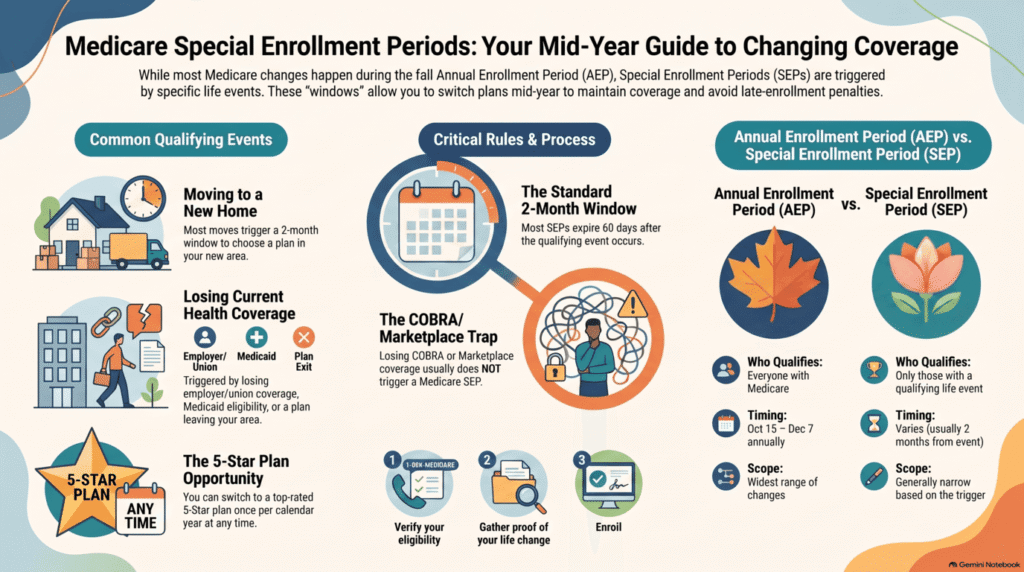
AEP is open to everyone with Medicare, runs the same seven weeks every year, and allows the widest range of changes. A SEP is triggered only by a specific qualifying event, is usually narrower in what it allows you to change, and the window length depends entirely on which trigger applies. If you don’t have a qualifying event, you’re limited to AEP or the Medicare Advantage Open Enrollment Period (Jan 1 – Mar 31) if you’re already in Medicare Advantage.
Just moved or lost coverage? Compare Medicare Advantage and Part D plans available at your new address.
How to Use a Special Enrollment Period
- Confirm you actually qualify. Not every life change creates a SEP—check the specific trigger against Medicare.gov’s list or call 1-800-MEDICARE to confirm.
- Act within the window. Most SEPs are time-limited; missing the window generally means waiting for the next AEP.
- Gather documentation. Proof of a move, a coverage termination letter, or Medicaid eligibility confirmation can speed up processing.
- Compare plans as you would during AEP. The comparison process is identical—see How to Switch Medicare Advantage Plans During Open Enrollment and Medicare Part D Open Enrollment: Comparing Drug Plans.
- Enroll online, by phone, or through a licensed agent, noting the SEP reason if asked.
Does a SEP Prevent a Late Enrollment Penalty?
In many cases, yes. Qualifying SEPs, such as losing creditable employer drug coverage, allow you to enroll in Part D without triggering the late enrollment penalty, as long as you act within the SEP window. See Medicare Open Enrollment Deadlines and Penalties for the full penalty rules and how they interact with SEP eligibility.
Common Misconceptions About SEPs
- “I can use a SEP anytime I want to switch plans.” No—a SEP requires an actual qualifying event; wanting a different plan isn’t itself a qualifying event.
- “A SEP gives me unlimited time to decide.” Most SEP windows are 2–3 months; some are shorter.
- “If I miss my SEP window, I’m stuck without coverage.” You may need to wait for the next AEP or Medicare Advantage Open Enrollment Period, but you generally won’t lose existing Original Medicare Part A/B coverage—only your ability to change Advantage or Part D plans on your preferred timeline.
SEPs for Chronic Condition Special Needs Plans
If you’re diagnosed with certain severe or disabling chronic conditions—such as end-stage renal disease, chronic heart failure, or diabetes—you may become eligible to enroll in a Chronic Condition Special Needs Plan (C-SNP) outside of AEP. These plans are designed specifically around managing a particular condition, often with tailored provider networks and care coordination programs, and enrollment eligibility is generally tied directly to your diagnosis rather than a set calendar window.
Working With Your State Health Insurance Assistance Program (SHIP)
Every state has a free, federally funded State Health Insurance Assistance Program that offers unbiased, one-on-one Medicare counseling, including help determining whether a specific life event qualifies you for a SEP. Unlike a licensed insurance agent, SHIP counselors don’t sell plans or earn commissions, which makes them a useful second opinion if you’re unsure whether your situation qualifies or which SEP category applies. You can find your state’s SHIP contact information through Medicare.gov.
Documenting Your SEP Request
When you enroll using a SEP, you’ll typically be asked to select the specific qualifying event from a list, and in some cases provide supporting documentation, such as a termination-of-coverage letter, a new lease or utility bill showing your move date, or a Medicaid approval letter. Keeping these documents on hand before you start the enrollment process can prevent delays, since a plan may place your enrollment on hold while it verifies SEP eligibility if documentation isn’t readily available.
How SEPs Fit Into Your Overall Enrollment Strategy
Even if you don’t currently qualify for a SEP, it’s worth understanding the categories so you recognize a qualifying event when it happens — a job change, a move, or a shift in eligibility for assistance programs can all open a window you’d otherwise miss simply because you didn’t know to look for it. Combined with the standard Annual Enrollment Period and the January–March Medicare Advantage Open Enrollment Period, SEPs round out the full picture of when and how Medicare coverage can change throughout the year.
COBRA and Marketplace Coverage: A Common Point of Confusion
COBRA continuation coverage and ACA Marketplace plans are not considered creditable coverage that delays your need to enroll in Medicare the way active employer coverage can. If you’re turning 65 and currently on COBRA or a Marketplace plan, you generally still need to enroll in Medicare during your Initial Enrollment Period to avoid the Part B and Part D late enrollment penalties — losing COBRA or Marketplace coverage later does not, by itself, typically open a Medicare SEP the way losing active employer coverage does. This is a frequent source of confusion and a costly one, since the penalty clock starts based on your Medicare eligibility date, not your COBRA or Marketplace enrollment status.
A Worked Example: Moving Mid-Year
Say someone enrolled in a Medicare Advantage HMO plan relocates from Arizona to a different county in June. Because the move takes them outside their plan’s service area, their SEP window opens the month before the move and runs for two full months after. During that window, they can select a new Medicare Advantage or Part D plan available in their new county, using the same comparison process as AEP — checking network, formulary, and star rating for the plans now available to them. If they don’t act within that roughly three-month window, they’d need to wait for the next AEP in the fall, potentially leaving them out-of-network in their new location for the rest of the year.
Frequently Asked Questions
What is a Medicare Special Enrollment Period?
A Special Enrollment Period (SEP) is a window outside the standard Annual Enrollment Period that lets you change Medicare Advantage or Part D coverage after a specific qualifying life event, such as moving, losing other coverage, or qualifying for Medicaid.
How long does a Special Enrollment Period last?
It depends on the trigger. Most SEPs last around 2 months from the qualifying event, though some, like the dual-eligible SEP, allow changes essentially monthly, and disaster-related SEPs can last several months.
Can I switch Medicare plans if I move to a new state?
Yes. Moving outside your current plan’s service area triggers a Special Enrollment Period that generally starts the month before your move and continues for 2 full months afterward.
Does losing employer health coverage qualify for a Special Enrollment Period?
Yes. Losing employer or union coverage typically triggers a SEP allowing you to enroll in Part B (if not already enrolled) and Part D within about 2 months, generally without a late enrollment penalty.
Can I switch to a 5-star Medicare plan anytime?
Yes, if a 5-star rated Medicare Advantage or Part D plan is available in your area, you can use the 5-star SEP to switch into it once per calendar year, outside the normal Annual Enrollment Period.
More in This Medicare Open Enrollment Guide
- Medicare Open Enrollment 2027: The Complete Guide
- Medicare Advantage vs. Original Medicare: How to Decide
- How to Switch Medicare Advantage Plans During Open Enrollment
- Medicare Part D Open Enrollment: Comparing Drug Plans
- Medigap vs. Medicare Advantage: Which Costs Less?
- Medicare Open Enrollment Deadlines and Penalties
- Medicare Advantage Star Ratings Explained
- Medicare Special Enrollment Periods: Do You Qualify?
- Medicare Costs in 2027: Premiums, Deductibles, and Limits
- Medicare Open Enrollment Checklist: 10 Questions to Ask
Not sure your current plan is still your best option?
Compare Medicare Advantage, Part D, and Medigap plans available in your ZIP code before the December 7 deadline.
SeniorAffair.com may earn a commission from partner links above. This does not affect our editorial coverage.
We are not connected with or endorsed by the U.S. government or the federal Medicare program.
© 2026 SeniorAffair.com — A 55+ Lifestyle Digital Magazine. Information on this page is general in nature and not a substitute for personalized advice from Medicare.gov, 1-800-MEDICARE, or a licensed insurance agent.