

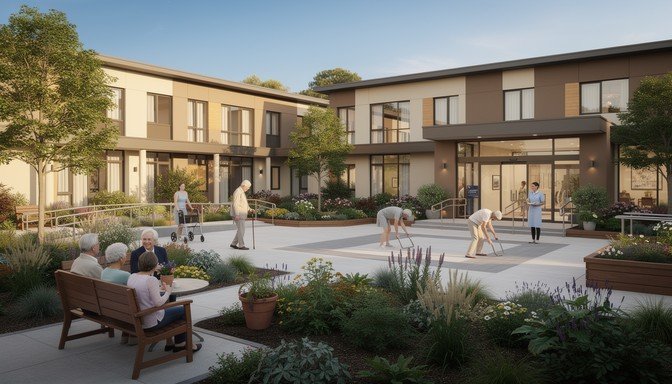
Choosing a senior living arrangement is one of the most significant decisions a family makes. The options are more varied — and more nuanced — than most people realize. Independent living and a nursing home are not the same thing. Memory care and assisted living serve different needs. A CCRC can be both.
This directory is designed to cut through the confusion. Each section covers a specific type of senior housing: what it is, the services it provides, who it’s best suited for, typical monthly costs, and the key pros and cons to weigh. Use the table of contents below to jump to a specific type, or read through from beginning to end to build a complete picture.
Aging in Place
Aging in place means a senior continues to live in their own home — or the home of a family member — as they grow older, rather than relocating to a senior living community or care facility. It is by far the most common arrangement; according to AARP, the overwhelming majority of older adults say they prefer to stay in their own home as long as possible.
Aging in place is not passive. For it to work safely and comfortably, most people eventually need some combination of home modifications, technology supports, and outside help — from paid caregivers, family members, or both.
Common Home Modifications
Physical adaptations are often the first step. These can range from minor safety upgrades to significant structural work:
- Grab bars and handrails in bathrooms and stairwells
- Walk-in showers or roll-in shower conversions
- Ramp installation at entrances
- Stairlift or residential elevator installation
- Widened doorways for wheelchair access (36 inches minimum)
- Lever-style door handles and faucets
- Non-slip flooring and improved lighting
- Single-level living arrangements (moving the bedroom to the ground floor)
Average Monthly Cost
$0 – $5,000+
Typical Resident
Independent to moderate care needs
Medical Care
Via visiting providers
Licensing Required
None
Advantages
- Familiar, comfortable environment
- Maximum autonomy and independence
- Lower cost when needs are minimal
- Stay connected to neighborhood and community
- No facility transition required
Considerations
- Can become isolating without social supports
- Home modifications can be costly
- Family caregiver burden may be significant
- Not feasible for complex medical needs
- Emergency response can be slower
Key question to ask: Is the home itself safe and modifiable? Does the person have reliable support — paid or family — for tasks they can no longer manage alone?
Independent Living Communities
Independent living communities — also called senior apartments, retirement communities, or 55+ communities — are residential settings designed specifically for older adults who are largely self-sufficient but want to downsize, reduce home maintenance, and gain access to a social community of peers.
These communities do not provide personal care or medical services as part of their standard offering. The appeal is lifestyle: maintenance-free living, on-site amenities, organized activities, and neighbors in a similar life stage. Residents typically live in private apartments or cottages and come and go as they please.
What’s Typically Included
Average Monthly Cost
$1,500 – $4,500
Typical Resident
Active adults 55–80+, independent
Personal Care Included
No (available add-on)
Medicare / Medicaid
Does not cover costs
Luxury independent living communities can run significantly higher — $5,000 to $10,000+ per month — depending on location, size of unit, and amenity level. Entry-fee models (common in CCRCs) require a large upfront payment in addition to monthly fees.
Advantages
- Built-in social community
- No home maintenance responsibilities
- Amenity-rich lifestyle
- Safety and security features
- Freedom and independence maintained
Considerations
- Cost can exceed some home situations
- No care services included as standard
- Moving again if care needs increase
- May feel too “institutional” for some
Assisted Living Facilities
Assisted living is one of the most common senior housing choices in the United States, with more than 30,000 licensed facilities serving roughly one million Americans. These communities provide a residential setting — private apartments or semi-private rooms — combined with on-site support for activities of daily living (ADLs): bathing, dressing, grooming, toileting, eating, and mobility.
Assisted living is designed for seniors who need regular help with personal care tasks but do not require the around-the-clock medical supervision provided by a skilled nursing facility. The goal is to support independence as much as possible while ensuring safety and meeting daily care needs.
Services Typically Provided
Average Monthly Cost
$4,500 – $6,500
National Median (2024)
~$5,350 / month
Typical Resident
Seniors needing daily care assistance
No (room & board not covered)
Medicaid
Some states offer waiver programs
State Licensed
Yes — all 50 states
How Pricing Works
Most assisted living facilities charge a base monthly rate that covers room, meals, and a standard set of services. Care level fees are then added on top based on how much personal assistance the resident requires. A resident who needs help with one or two ADLs might pay $500–$1,000 more per month than the base rate; someone requiring extensive help across all ADLs could pay $2,000–$3,000 more. Always ask for a complete fee disclosure, including all add-on charges.
Medicare note: Medicare does not cover assisted living room and board. It may cover short-term skilled nursing or therapy services delivered on-site in some cases. Medicaid’s coverage of assisted living varies significantly by state — some states offer Home and Community Based Services (HCBS) waivers that can offset costs.
Advantages
- Professional 24-hour staff support
- Social community and programming
- Relieves family caregiver burden
- Safer environment than home for many
- Flexible care levels as needs change
Considerations
- Significant monthly cost
- Medicare doesn’t cover most costs
- Care add-on fees can grow quickly
- Quality varies widely by facility
- May need to move if medical needs escalate
Memory Care Communities
Memory care is a specialized form of senior housing designed specifically for individuals living with Alzheimer’s disease, dementia, or other forms of cognitive impairment. It may exist as a stand-alone community or as a dedicated wing within an assisted living facility or CCRC.
What distinguishes memory care from standard assisted living is its specialized design, staffing, and programming. The physical environment is engineered to reduce disorientation and prevent wandering — common and dangerous behaviors in people with moderate to advanced dementia. Staff-to-resident ratios are higher, and caregivers receive specific dementia-care training.
Key Features of Memory Care Communities
- Secured perimeter: Doors with keypads or delayed egress systems to prevent unsupervised wandering
- Simplified floor plans: Circular hallways and clear wayfinding to reduce confusion
- Sensory programming: Music therapy, reminiscence activities, and sensory gardens tailored to cognitive function levels
- Higher staffing ratios: Typically 1 staff member per 4–6 residents vs. 1 per 8–10 in standard assisted living
- Structured daily routines: Predictable schedules that reduce anxiety in cognitively impaired residents
- Dementia-certified staff: Training in de-escalation, redirection, and behavioral management
Average Monthly Cost
$5,500 – $8,000
Cost vs. Assisted Living
20–35% higher on average
Ideal Candidate
Moderate to advanced dementia
Does not cover room & board
When is memory care the right move? Signs that it may be time to consider memory care include: a loved one getting lost in familiar surroundings, leaving the stove on repeatedly, declining personal hygiene despite reminders, aggressive or dangerous behavior, and nighttime wandering that disrupts the household. Family caregivers often delay this transition too long — earlier placement can mean a smoother adjustment for the resident.
Advantages
- Staff trained specifically for dementia
- Safe, secured environment
- Structured programming supports cognitive function
- Peer community of similar residents
- Relief for overwhelmed family caregivers
Considerations
- Higher cost than standard assisted living
- Resident may resist or not recognize the need
- Quality of dementia care varies between facilities
- Limited Medicare / Medicaid coverage
Skilled Nursing Facilities (Nursing Homes)
Skilled nursing facilities (SNFs) — commonly called nursing homes — represent the highest level of residential care available outside a hospital. They provide 24-hour medical supervision along with nursing care, rehabilitation services (physical, occupational, and speech therapy), and personal care for seniors with serious, complex, or chronic health conditions.
SNFs serve two distinct populations: (1) short-term rehabilitation patients who have recently had surgery, a stroke, a fall, or other acute illness and are recovering before returning home; and (2) long-term residents who require ongoing skilled nursing care because they can no longer safely live in a less intensive setting.
Medical and Therapeutic Services
Semi-Private Room (avg)
$8,000 – $9,500 / mo
Private Room (avg)
$9,500 – $11,000 / mo
Medicare Coverage
Up to 100 days (qualifying stay)
Medicaid
Yes — primary payer for many
Medicare Coverage Rules
Medicare Part A covers skilled nursing facility care, but only under specific conditions: the patient must have had a qualifying hospital stay of at least three consecutive days, must require skilled nursing or therapy services, and must be admitted to a Medicare-certified facility. Coverage is 100% for days 1–20; days 21–100 require a significant daily copay; and after day 100, Medicare coverage ends entirely. Long-term nursing home care is primarily funded by Medicaid (after the resident has spent down most of their own assets) or private funds.
Advantages
- Highest level of residential medical care
- Registered nurses on-site 24/7
- Comprehensive rehabilitation services
- Medicaid funding available for eligible residents
- Appropriate for complex multi-condition needs
Considerations
- Highest cost of any residential option
- Can feel clinical or institutional
- Less autonomy than other settings
- Long-term private-pay cost exhausts savings quickly
- Staff ratios vary widely by facility
Continuing Care Retirement Communities (CCRCs)
A Continuing Care Retirement Community (CCRC) — now often called a Life Plan Community — is a single campus that provides multiple levels of care under one roof: independent living, assisted living, memory care, and skilled nursing. Residents can move between care settings as their needs change without leaving the campus.
CCRCs are designed to serve people for the rest of their lives. The core promise: you choose a community when you’re healthy and independent, and that community supports you through whatever health changes come. You and your spouse don’t have to separate when one of you needs more care than the other.
Contract Types
CCRCs are unique in that they typically require a large entrance fee (also called a buy-in) in addition to monthly fees. There are three primary contract structures:
- Type A — Life Care (Extensive): Higher entry fee but minimal increase in monthly fees even as care needs escalate. Provides the most financial predictability.
- Type B — Modified: Lower entry fee, but the resident pays more for care services on a fee-for-service basis as needed. Middle ground.
- Type C — Fee-for-Service: Lowest entry fee; residents pay the full market rate for each level of care as they need it. Most financially risky if needs increase significantly.
Entry Fee Range
$100K – $1M+
Monthly Fee
$3,000 – $7,000+
Entry Fee Refundable?
Varies by contract (0–90%)
Ideal For
Independent seniors planning ahead
Due diligence is essential. Before signing a CCRC contract, have an elder law attorney and a financial advisor review it. Understand what percentage of the entry fee is refundable, what happens if the facility closes, and exactly which care transitions trigger additional fees.
Advantages
- “Age in one place” for life — across all care levels
- Couples can remain on same campus
- Predictable costs (with Type A contracts)
- Rich amenities and programming
- High-quality care continuity
Considerations
- Very high upfront entry fee
- Contracts are complex and long
- Financial health of the CCRC matters
- Not appropriate for people already needing significant care
Residential Care Homes (Board & Care)
Residential care homes — also called board and care homes, adult family homes, or group homes — are small, private residences (typically serving 2–10 residents) licensed to provide personal care and meals in a home-like setting. They are run by operators who either live on-site or employ live-in caregivers.
These homes offer an important alternative for seniors who want more personalized, small-scale care than a large assisted living facility but whose needs exceed what home care alone can provide. The intimate setting is especially valued by seniors who find large facilities overwhelming or impersonal.
Average Monthly Cost
$3,000 – $6,500
Capacity
2–10 residents typically
Care Level
Personal care; not skilled nursing
Licensing
State regulated; varies widely
Advantages
- Home-like, intimate environment
- High caregiver-to-resident ratio
- Often more affordable than large ALFs
- More individualized care and meals
- Less institutional feel
Considerations
- Fewer social and recreational activities
- Less regulatory oversight than large facilities
- Operator quality varies widely
- Not appropriate for high medical needs
- Limited medical staff on-site
Adult Day Services (Adult Day Programs)
Adult day services (ADS) — sometimes called adult day care or adult day health care — provide structured programs during daytime hours for seniors who benefit from socialization, supervision, and health monitoring, while their family caregivers are at work or need respite. Participants go home in the evenings.
ADS is not a residential housing option but is a critical part of the senior care continuum. It can significantly extend the time a person can safely remain at home by filling the daytime hours with professional supervision and engaging programming, while reducing caregiver burnout.
Types of Adult Day Programs
- Social adult day programs: Focus on socialization, recreational activities, meals, and light supervision. Best for seniors with mild cognitive or physical limitations.
- Adult day health care (ADHC): Add medical and therapeutic services — nursing assessment, medication management, physical and occupational therapy — for seniors with more complex health needs.
- Dementia-specific programs: Memory-focused programming, secured environments, and staff trained in dementia care for participants with Alzheimer’s or other cognitive impairments.
Average Daily Cost
$75 – $150 / day
Monthly Estimate
~$1,500 – $3,000
Medicaid
May be covered (state-dependent)
Hours
Typically 6–8 hours, weekdays
Advantages
- Allows continued home living
- Provides critical respite to family caregivers
- Social engagement and stimulation
- Lower cost than residential alternatives
- Medicaid may offset costs
Considerations
- Daytime-only — does not cover evenings or nights
- Transportation to program must be arranged
- Not appropriate for those needing 24-hour supervision
- Program quality varies significantly
In-Home Care Services
In-home care brings professional assistance directly into the senior’s existing home, allowing them to receive the support they need without relocating. This is the fastest-growing segment of senior care, driven both by consumer preference for aging in place and by the increasing sophistication of home-based care delivery.
There are two distinct categories of in-home services, which are important to distinguish:
Non-Medical Home Care
Provided by home health aides, personal care aides, and companions who help with ADLs — bathing, dressing, grooming, meal preparation, light housekeeping, medication reminders, and transportation — but do not provide skilled medical services. Sometimes called home care or custodial care.
Skilled Home Health Care
Provided by licensed medical professionals (registered nurses, physical therapists, occupational therapists, speech therapists) on a part-time or intermittent basis following a hospitalization, surgery, or for management of a chronic condition. Medicare Part A or Part B may cover qualifying home health visits when a physician orders them.
Home Care Aide (avg)
$25 – $35 / hour
Live-In Care
$200 – $400 / day
Medicare Covers
Skilled home health (qualifying)
Non-Medical Care
Private pay / long-term care ins.
Advantages
- Senior stays in own home
- Highly customizable — choose hours and tasks
- One-on-one attention
- Medicare covers qualifying skilled visits
- Can supplement family caregiver effort
Considerations
- 24-hour care costs rival facility costs
- Managing caregivers is an ongoing task
- No built-in social community
- Home may not be suitable for escalating needs
- Turnover among home care aides is common
Side-by-Side Comparison
All nine senior housing and care options at a glance.
| Housing Type | Monthly Cost | Care Level | Medicare | Medicaid | Best For |
|---|---|---|---|---|---|
| Aging in Place | $0 – $5,000+ | None to moderate (home care) | Skilled home health only | HCBS waivers | Independent seniors; strong home support network |
| Independent Living | $1,500 – $4,500 | None standard | No | No | Active, independent seniors 55+ |
| Assisted Living | $4,500 – $6,500 | Personal care (ADLs) | No | Some states | Seniors needing daily personal care |
| Memory Care | $5,500 – $8,000 | Personal care + dementia | No | Some states | Alzheimer’s / dementia residents |
| Skilled Nursing | $8,000 – $11,000 | 24-hr medical nursing | Short-term (up to 100 days) | Yes | Complex medical / rehab needs |
| CCRC / Life Plan | $3,000 – $7,000+ (+ entry fee) | IL → AL → MC → SNF | For skilled portions only | Rarely | Seniors planning long-term; couples |
| Residential Care Home | $3,000 – $6,500 | Personal care | No | Some states | Seniors who prefer small, intimate settings |
| Adult Day Services | $1,500 – $3,000 | Supervision + social | No (ADHC sometimes) | Yes (often) | Daytime supervision; caregiver respite |
| In-Home Care | $2,000 – $15,000+ | Personal care to skilled | Skilled visits (qualifying) | HCBS waivers | Seniors who prefer to stay home |
How to Choose the Right Senior Housing Type
No two families’ situations are identical. These four questions provide a practical framework for narrowing your options.
1. What level of care is genuinely needed — today, and in two to three years?
Start with a realistic, honest assessment of current needs — not the minimum that could be justified. Consider: Can the person manage bathing, dressing, and meals independently? Are medications taken correctly without reminders? Is there any cognitive impairment affecting safety? Then project forward. A senior who needs help with two ADLs today may need five-point care within eighteen months. Choosing a setting that has room to grow avoids a painful move at a worse time.
2. What is the realistic budget — and what are the funding sources?
Private savings, Social Security, pension income, long-term care insurance, and VA benefits all play a role. For some families, Medicaid will ultimately be the primary payer — and Medicaid coverage rules differ dramatically by housing type and by state. Understanding the financial runway early determines which options are realistic and which are not. An elder law attorney or certified senior advisor (CSA) can be invaluable here.
3. What does the senior want?
Where feasible, the senior’s own preferences should anchor the decision. Some people deeply value staying home; others are lonely and would thrive in a community setting. Some fear losing independence; others would welcome a move if they understood what a good community offers. Touring multiple options together — even as a “just looking” exercise — often changes perceptions on both sides.
4. What do family support resources look like?
A senior with three nearby adult children who can coordinate rotating visits and caregiver support has very different options than one whose family lives across the country. Be honest about what family members can realistically sustain, not just what they are willing to commit to in a moment of urgency.
Paying for Senior Housing
Understanding your payment options before a crisis occurs is one of the most protective steps a family can take.
Private Pay (Out of Pocket)
The majority of assisted living and independent living is paid privately — from savings, retirement accounts, Social Security, pension income, or proceeds from selling a home. Most seniors begin as private-pay residents in whatever setting they choose.
Long-Term Care Insurance (LTCI)
Policies purchased before care is needed can cover a significant portion of assisted living, memory care, or nursing home costs. Benefit structures vary; most policies have an elimination period (waiting period) and a maximum daily benefit. LTCI policies purchased more than five years ago may have lower benefit amounts than current daily rates.
Medicare
Medicare covers skilled nursing facility care for up to 100 days per benefit period after a qualifying hospital stay (with significant cost-sharing after day 20). Medicare covers qualifying skilled home health visits. Medicare does not cover assisted living, memory care, independent living, room and board in a nursing home, or custodial (non-medical) home care.
Medicaid
Medicaid is the largest single payer for nursing home care in the United States. Eligibility is income- and asset-based and varies by state. Many states also offer Home and Community Based Services (HCBS) Medicaid waivers that can fund assisted living, residential care homes, adult day services, and in-home care for qualifying individuals. Medicaid planning with an elder law attorney should happen well in advance if this pathway is anticipated.
Veterans Benefits
The VA Aid & Attendance benefit provides additional pension income to eligible veterans and surviving spouses who need help with ADLs — and can be a meaningful contributor to senior housing costs. The VA also operates its own network of Community Living Centers (CLCs), which provide skilled nursing level care to eligible veterans, often at low or no cost.
Bridge Loans and Life Settlements
Senior bridge loans can provide short-term funds to pay for senior housing while waiting for a home to sell or an insurance claim to process. Life settlements — selling a life insurance policy to a third party for more than the cash surrender value — can also unlock capital for senior housing costs.
Find the Right Community for Your Family
Browse our curated directory of assisted living, memory care, and independent living communities — with verified reviews, pricing ranges, and care level information.
Search Communities Near You Download Our ChecklistFrequently Asked Questions
What are the main types of senior housing?
The main types are: aging in place (in one’s own home), independent living communities (55+ communities), assisted living facilities, memory care communities, skilled nursing facilities (nursing homes), continuing care retirement communities (CCRCs), residential care homes (board and care), adult day services, and in-home care. Each serves a different level of need and degree of independence.
What is the difference between assisted living and a nursing home?
Assisted living provides help with daily personal care tasks (bathing, dressing, medications) in a residential setting, for seniors who are largely independent but need some ongoing support. A nursing home (skilled nursing facility) provides 24-hour medical nursing care and therapeutic services for seniors with serious, complex, or chronic health conditions. Nursing homes are significantly more expensive and medically intensive than assisted living.
Does Medicare cover assisted living?
No. Medicare does not cover assisted living room and board. It may cover skilled nursing or therapy services provided on-site in limited circumstances. Medicaid may cover some assisted living costs through state waiver programs, but eligibility requirements vary by state. Most assisted living residents pay privately or use long-term care insurance.
What is a CCRC or Life Plan Community?
A Continuing Care Retirement Community (CCRC) — also called a Life Plan Community — is a campus offering multiple levels of care (independent living, assisted living, memory care, skilled nursing) in one location. Residents pay a large entry fee upfront and monthly fees, and can move between care levels as their needs change without relocating to a different community. It is designed to serve a person for the rest of their life.
How much does assisted living cost per month?
The national median cost of assisted living is approximately $5,350 per month as of 2024, though costs range from about $3,000 in lower-cost markets to $8,000 or more in high-cost cities. Costs also increase based on the level of personal care required — facilities typically charge a base rate plus care-level add-on fees.
When should someone move to memory care instead of assisted living?
Consider memory care when a person with dementia begins wandering or getting lost, can no longer manage basic safety tasks, shows significantly increased behavioral symptoms (agitation, aggression, paranoia), or poses a risk to themselves or others in a standard assisted living setting. Memory care communities have secured environments, specially trained staff, and programming designed for moderate to advanced cognitive impairment.
Can Medicaid pay for assisted living?
It depends on the state. Medicaid does not universally cover assisted living. However, many states offer Home and Community Based Services (HCBS) Medicaid waivers that can pay for personal care services delivered in an assisted living setting for eligible individuals. Medicaid is the primary payer for long-term skilled nursing facility care in all states. An elder law attorney can advise on your state’s specific programs and Medicaid planning strategies.
What is a residential care home or board and care home?
A residential care home (also called a board and care home, adult family home, or group home) is a small, private house licensed to provide personal care and meals to typically 2–10 senior residents. They offer a more intimate, home-like alternative to large assisted living facilities, often with higher caregiver-to-resident ratios and lower costs — but fewer amenities and recreational programs.
What questions should I ask when touring a senior living community?
Key questions include: What is included in the base monthly fee and what are add-on charges? What is the staff-to-resident ratio? What happens if my loved one’s care needs increase — will they have to move? What is the staff turnover rate? How are medical emergencies handled? What is the community’s state inspection history? Can I speak with current residents or family members? Ask to see the most recent state inspection report, which is public record.