

A folding scooter listing says “airline approved.” That sounds settled. It isn’t.
No scooter is truly “airline approved.” There is no FAA approval for a mobility scooter or its battery. Each airline sets its own rules, and those rules change. The time to check is before you buy, not at the gate.
This article covers the one number that matters, how the airlines differ, and a five-minute check you can run on any scooter before you pay.
The one number that matters: your battery’s watt-hours
The airline doesn’t rule on the scooter. It rules on the battery.
Find the watt-hour (Wh) rating on the battery label. If Wh isn’t printed, multiply volts (V) by amp-hours (Ah). For example, a 25.2V, 10Ah battery is 252 Wh. That is under the 300 Wh limit below.
Here is the federal rule for wheelchairs and mobility devices, from the FAA’s PackSafe guidance:
- If the battery must be removed: a lithium-ion battery is limited to 300 Wh. You may bring one spare up to 300 Wh, or two spares up to 160 Wh each. Spares go in carry-on only.
- If the battery stays installed and is adequately protected inside the device, the federal rule sets no watt-hour limit. The FAA says it is preferable that the battery remain installed.
- Removed batteries fly in the cabin. Never in a checked bag, on any airline.
- Non-rechargeable lithium metal batteries are not allowed with these devices.
There is one common mix-up. You will see 100 Wh and 160 Wh limits everywhere online. Those are for laptops, cameras and power banks. They are not the mobility-device rules. Don’t apply them to a scooter.
Why “airline approved” is a label, not a guarantee
No FAA-approved battery exists, whatever a listing says. Sellers use the phrase loosely. It usually means “the battery is under 300 Wh,” or it means nothing at all.
Ask the seller three things instead:
- What is the exact battery rating in watt-hours?
- Is the battery removable?
- Is the Wh printed on the battery label?
If the seller can’t answer those three questions, that is your answer.

The airlines don’t agree with each other
Start with the good news. Under the Air Carrier Access Act, US airlines must carry your mobility scooter free of charge as an assistive device. You ride it through screening to the gate. The airline loads it in the hold and returns it at the aircraft door.
On top of that floor, the carriers differ, and their pages change without notice. As of late November 2026:
- Alaska is the strictest. The battery must be easily removable. A non-removable battery is refused. The label must be legible and in English.
- Delta is the most permissive on batteries. It is also the only carrier with a genuinely mandatory form.
- American publishes no watt-hour limit for mobility devices. It tells you to phone instead.
- United no longer publishes a limit. The federal 300 Wh rule governs.
- Southwest requires the battery to be removed outright. Plan around the 300 Wh figure.
The takeaway: the strictest airline on your itinerary sets your real limit. On a trip with more than one flight, check every carrier. Then confirm on the airline’s own website the week you fly.
The 5-minute check before you buy any folding scooter
Run this on any listing before you pay:
- Battery watt-hours. Is the Wh printed on the label? Is it under 300 Wh?
- Removable battery. Can you take it out easily? Some airlines require removal.
- Clear label. Does it show volts and amp-hours clearly, in English?
- Folded size and weight. Will it fit through the cargo door? Can the crew handle it?
- Written answers. Does the seller answer the battery questions in writing?
If any answer is missing, call the airline before you buy, not after.
At the airport: what happens
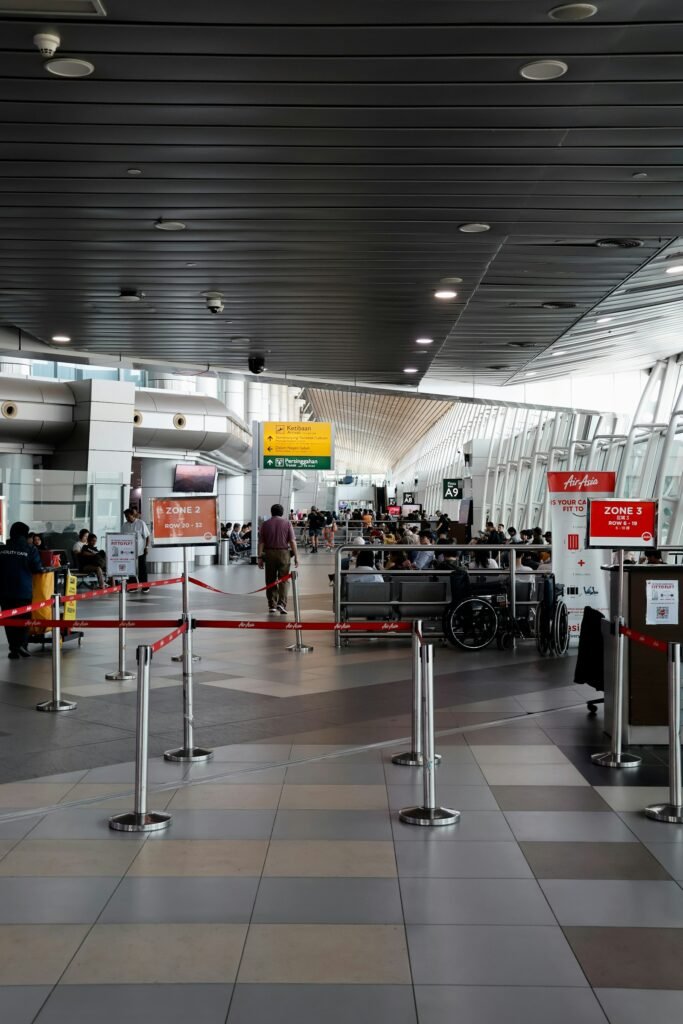
TSA screens scooters every day. Ride yours to the gate.
Tell the airline where the battery is. The crew must tell the pilot. If you remove the battery, cover the terminals with tape or the original caps. Keep it in a protective pouch, and carry it on board.
The airline must not drain the battery or disconnect a non-spillable battery that is fully enclosed in the scooter’s case, unless a safety rule requires it.
When your scooter goes into the cargo hold, protect it. Take photos before you hand it over, and remove any loose parts such as baskets, cup holders and the key.
If it won’t fly: the fallback
If the numbers don’t work, renting a scooter at your destination is often the easier choice. Ask the rental company:
- Will they deliver to your hotel?
- Are the battery and charger included?
- How does pickup work at the end of your stay?
Frequently Asked Questions
Is any folding mobility scooter FAA approved?
No. There is no FAA approval for a mobility scooter or its battery. Each airline sets its own rules for the battery, and those rules change.
What is the battery limit for flying with a mobility scooter?
Under the FAA’s PackSafe guidance, a lithium-ion battery that must be removed is limited to 300 Wh, with one spare up to 300 Wh or two spares up to 160 Wh each, carried in the cabin. A battery that stays installed and protected has no federal watt-hour limit, but airlines can be stricter.
How do I find my scooter battery’s watt-hours?
Look for Wh on the battery label. If it is not printed, multiply volts by amp-hours. A 25.2V, 10Ah battery is 252 Wh.
Do airlines charge to carry a mobility scooter?
No. Under the Air Carrier Access Act, US airlines must carry your mobility scooter free of charge as an assistive device.
Bottom line
Buy the battery, not the label. Look for under 300 Wh, removable, and clearly labeled. Then confirm with your airline.
The few minutes you spend checking before you buy cost far less than finding out at the gate.
Airline rules as of late November 2026. Source for battery limits: FAA PackSafe guidance for wheelchairs and mobility devices. Confirm with your airline the week you fly.
Get guides like this in your inbox
Medicare changes, money tips, health guides and deals for adults 55+. Free, from Senior Affair Magazine.
Free. Unsubscribe anytime. Privacy policy.