


Yes, the Anker SOLIX S5000 can run a full electric range. In Anker’s own demo, an electric oven preheats to 350°F while drawing about 4,600 watts, all powered by a battery on wheels. There are two catches. The first is time: at that draw, the battery lasts roughly one hour, so it is built for a hot meal in an outage, not all-day baking. The second is wiring: most ranges can’t simply plug into it, which we explain below.
SeniorAffair may earn a commission if you buy through links on this page, at no extra cost to you. It does not affect our coverage.
- Powers: 120V and 240V loads up to 4,500W continuous (8,000W peak), including an electric range, well pump and furnace.
- Capacity: 5,024Wh, enough for a cooked meal, but only about an hour of full oven draw.
- Best at: keeping a fridge, lights, Wi-Fi and household-power medical devices running for a day or two.
- Not: whole-home automatic backup. It is a 97 lb plug-in unit. Everyday 120V appliances need no installation, but hardwired loads like a range, well pump or furnace need a transfer switch.
- Price: $3,599.99 list; sale prices have been much lower. Check the live price.
How we reviewed it: this article is based on Anker’s published specifications and third-party testing, not our own hands-on testing. We note whenever a figure is Anker’s claim.
What the S5000 is
The SOLIX S5000 is a large portable power station that Anker announced on October 9, 2026, with U.S. sales starting October 27. It is essentially a rolling battery cabinet. For anything with a normal plug, there is no installation: you wheel it where you need it and plug things in.
| Spec | S5000 |
|---|---|
| Capacity | 5,024Wh, lithium iron phosphate (LFP) |
| Output | 4,500W continuous, 8,000W peak; 120V and 240V |
| Outlets | Four standard 120V outlets (2,400W combined), one TT-30R RV outlet (3,600W), one 240V L14-30R outlet (4,500W) |
| Size and weight | 97 lb; 10.6 × 22.0 × 15.2 in; wheels and telescoping handle |
| Battery life | Rated 6,000 cycles to 80% capacity, 10,000 cycles to 60%; 5-year warranty |
| Recharging | As little as 99 minutes (0–100%) on 240V AC plus solar; up to 3,000W solar input; also generator or car |
| Switchover | 10 milliseconds or less in UPS mode |
| Expansion | Up to five BP5000 batteries, 5 kWh to 30 kWh |
| Noise | About 30 dB, quieter than normal conversation |
The 240V outlet is the key feature. Smaller stations are limited to 120V, which rules out an electric range, dryer, many well pumps and some furnaces. Anker’s marketing says the S5000 can power “99% of your 120V/240V appliances.” Treat that as a sales line, but the spec sheet does back up the important part.
One independent test, by ESS News, measured usable capacity at 4.87 kWh, about 97% of the rated 5,024Wh.
The oven question, answered straight
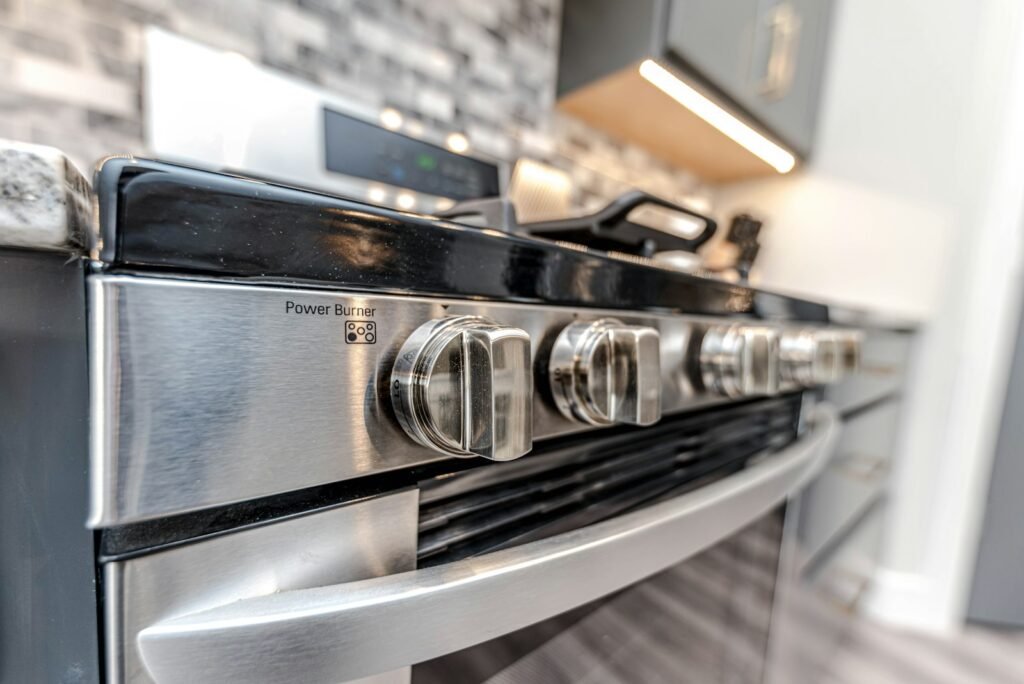
The oven in the demo draws about 4,600W while preheating. The S5000 holds 5,024Wh. Divide one by the other and you get a little over an hour of runtime at full draw, with nothing else plugged in. That is our own calculation from the rated capacity, not an Anker figure.
So the demo proves the range works. It does not prove you can bake all day. Here is what that means in a real outage:
- Preheating and cooking a meal: yes. An oven cycles on and off once it reaches temperature, so a 30 to 45 minute cook uses far less than an hour of full draw. A casserole, a pot of soup or a tray of chicken is realistic.
- Boiling water and reheating: yes, easily. A kettle or microwave runs for minutes, not hours.
- Oven, fridge and lights at once: watch the total. The demo oven’s 4,600W preheat is right at (slightly above) the 4,500W continuous rating, and a fridge adds a startup surge. The 8,000W peak covers short surges, but cook first, then let everything else run.
- Hours of baking: no. That is a job for a fixed home battery system or a generator.
Think of it this way: the S5000 turns an outage from cold sandwiches into a hot meal, as long as you cook in normal-length sessions.
What else it runs: the part that matters most
The oven is the headline, but everyday outage loads are where a battery like this earns its keep.
- Fridge and freezer: Anker says a fridge alone can run up to 86 hours on a charge. A fridge, Wi-Fi router, coffee maker, lights and phone charging together are rated by Anker at up to 48 hours.
- Staying connected: phones, a laptop, Wi-Fi and a lamp can run for days.
- Heat: a gas furnace’s fan and controls, or a space heater in short sessions. Heaters are heavy loads, like the oven.
- Water: a well pump or sump pump, both 240V in many homes and both beyond smaller stations.
The 48-hour figure is for light essentials, not cooking. Both numbers describe different days, so plan around the light-load day and treat the oven as a bonus you use deliberately.
The portability reality
At 97 pounds, the S5000 is not light, but the wheels and pull handle do the work on flat floors. In a garage, kitchen or living room, one person can move it. Stairs are a two-person job, so decide where it will live before the storm. Anker says it is 45% smaller and 28% lighter than the average 5 kWh station.
It is also quiet and fume-free. There is no gas to store, no exhaust and no starter cord to pull in the rain. For anyone who has wrestled a gas generator, that is the real quality-of-life difference.
What it costs
- List price: $3,599.99.
- Launch price: $2,499.99, which ran October 27 to November 9, 2026. That window has closed.
- Black Friday: Anker’s early Black Friday sale has the S5000 at about $2,470 with retailer discount codes, and deal sites briefly saw $2,375 in early November. Prices are moving fast this week, so confirm the current price directly with Anker or a major retailer before you buy.
- Transfer switch bundle: if you want the range, well pump or furnace, budget for the switch plus an electrician. Anker lists the S5000 with its transfer switch at $4,199.99 before discounts.
- Expansion batteries: BP5000 add-on packs grow the system up to 30 kWh. Price them separately. They are the multi-day answer if outages in your area last longer than two days.
For plug-in appliances there is no installation cost, unlike a fixed whole-home system. Solar panels and a generator are optional add-ons, not requirements.
Who should buy it, and who should skip it
Buy it if your outages last hours to a couple of days, you need 240V for a well pump, furnace, dryer or range (and are willing to add a transfer switch), or you want one box that covers the fridge, essential devices and cooking. Renters can use it for plug-in appliances with no installation at all.
Skip it if you have no space to store a 97 lb unit, your outages regularly run past two days and you don’t want to add batteries or solar, or you need true automatic whole-home backup. That calls for a fixed, panel-wired system, not a portable station.
The middle option: a smaller, cheaper station covers phones, lights and a fridge for a day. The S5000 is for people who also want the stove, the well pump and a second day.
Bottom line
The demo is real: the S5000 runs a full electric range. The limit is capacity, not power. An oven at full draw empties a 5 kWh battery in about an hour, so cook in normal sessions and let the battery do its best work on the fridge, lights and essential devices for the rest of the outage. For a household that wants to stay put, stay warm and eat a hot meal without a gas generator, it is one of the most capable portable stations Anker has made. Check the live price and your own appliance wattages before deciding.
Frequently asked questions
Can the Anker SOLIX S5000 run an electric stove?
Yes, through its 240V outlet. Anker’s demo shows an oven preheating to 350°F at about 4,600W, right at the 4,500W continuous limit. At that draw the battery lasts roughly an hour, so it suits normal cooking sessions, not all-day baking. Most ranges need a transfer switch installed by an electrician to connect.
How long will it power a refrigerator?
Anker says a fridge alone can run up to 86 hours, and a fridge plus router, coffee maker, lights and phone charging up to 48 hours. These are Anker’s figures.
How much does it cost?
List price is $3,599.99. A $2,499.99 launch price has ended. Early Black Friday deals are around $2,470 with retailer codes. Check the live price.
Is it a whole-home backup system?
No. It is a portable unit. Plug-in appliances need no installation, but hardwired loads need a transfer switch, and automatic whole-home backup requires a fixed, panel-wired system.
Sources: Anker SOLIX product page (specifications and list price); Digital Trends and Notebookcheck (launch pricing, cycle life, outlets); The Gadgeteer (outlet power ratings); ESS News (tested usable capacity); Electrek and 9to5Toys (Black Friday pricing, November 2026); Anker SOLIX demo reel. Claims attributed to Anker are the manufacturer’s own. This article is for general information, and this edition was reviewed and edited by our editorial team.
Get guides like this in your inbox
Medicare changes, money tips, health guides and deals for adults 55+. Free, from Senior Affair Magazine.
Free. Unsubscribe anytime. Privacy policy.