


Learn how CMS calculates Medicare Advantage star ratings, why they matter, and how to use them to compare plans during Open Enrollment.
By the SeniorAffair.com Medicare Team · Reviewed for accuracy against CMS.gov and Medicare.gov
Every Medicare Advantage and Part D plan gets a public quality score from CMS, from 1 to 5 stars, updated once a year. It’s one of the fastest ways to gauge a plan’s real-world performance before you commit to it during Open Enrollment — but most people never look at it, and most who do don’t know what it’s actually measuring.
Article Contents
What the Star Rating System Measures
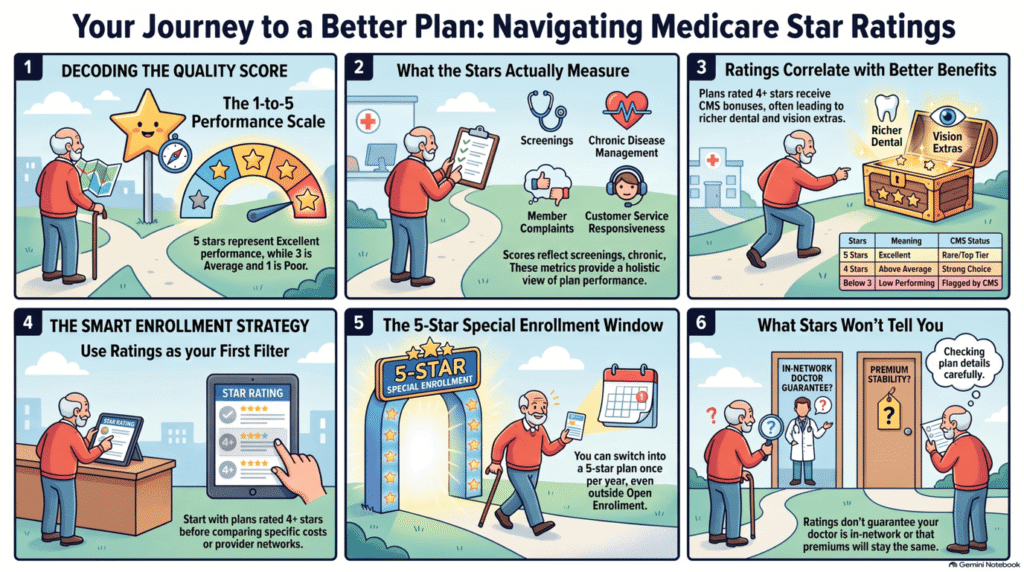
CMS calculates star ratings using dozens of individual measures grouped into broad categories:
- Staying healthy: screenings, tests, and vaccines members received
- Managing chronic conditions: how well the plan supports members with diabetes, heart disease, and other ongoing conditions
- Member experience: survey results on ease of getting care and satisfaction with the plan
- Member complaints and plan performance: complaint volume, disenrollment rates, and how quickly the plan resolves appeals
- Customer service: call center responsiveness and accuracy
Part D-specific measures also factor in medication safety and accuracy of drug pricing information provided to members. A plan’s overall star rating is a weighted average across all these individual measures.
How to Read the Rating
| Stars | What It Signals |
|---|---|
| 5 stars | Excellent performance; rare and highly regarded |
| 4 stars | Above-average performance |
| 3 stars | Average performance |
| 2 stars | Below-average performance; may signal recurring member issues |
| 1 star | Poor performance; CMS may restrict marketing for consistently low-rated plans |
Plans rated consistently below 3 stars for three years in a row are flagged by CMS as “low performing,” and CMS may limit how those plans can be marketed to new members.
Where to Find a Plan’s Star Rating
Star ratings are published on Medicare.gov’s Plan Finder tool alongside each plan’s cost estimate—you don’t need a separate lookup. They’re also listed on CMS’s public Medicare Plan Ratings data release each fall, ahead of the start of AEP. When comparing plans while switching, as covered in How to Switch Medicare Advantage Plans During Open Enrollment, the rating appears right next to each plan’s cost and coverage details.
See star ratings alongside cost and network details for every plan available in your ZIP code.
Why Star Ratings Matter Beyond Bragging Rights
1. They correlate with real member experience
Because a large share of the rating comes from actual member surveys and complaint data, not just marketing claims, a consistently 4- or 5-star plan tends to mean fewer customer service headaches, more accurate claims processing, and better-managed chronic care programs.
2. 5-star plans unlock a special enrollment opportunity
If a 5-star Medicare Advantage or Part D plan is available in your area, you can enroll in it during a special year-round enrollment period, once per year, outside the normal AEP window. This is covered in more detail in Medicare Special Enrollment Periods: Do You Qualify?.
3. CMS uses ratings to determine bonus payments to plans
Plans rated 4 stars or higher receive bonus payments from CMS, which can translate into more generous supplemental benefits — part of why higher-rated plans often, though not always, offer richer extras like dental and vision allowances.
What Star Ratings Don’t Tell You
- They don’t guarantee your specific doctor is in-network. Rating and network adequacy are measured separately.
- They don’t reflect this specific year’s premium or copay changes. Ratings are based on the prior year’s performance data, not next year’s pricing.
- They’re an average across the whole plan membership, not personalized to you. A plan can be excellent at managing diabetes care and mediocre at customer service — the overall star rating blends both into one number.
- A high rating doesn’t mean the plan is the cheapest option for your specific medications. Cost and quality are separate axes worth comparing independently.
How Ratings Change Year to Year
CMS recalculates ratings annually based on the most recent full year of data, so a plan’s rating can rise or fall from one Open Enrollment to the next. A plan that was 4 stars last year isn’t guaranteed to stay at 4 stars, which is another reason to re-check ratings during your annual review rather than relying on what you remember from a previous year.
Start with the 4-and-5-star plans in your area, then compare their costs and networks in one place.
Using Star Ratings Alongside Cost Comparisons
The most effective way to use star ratings is as a filter, not a final answer. Start by identifying plans in your area rated 4 stars or higher, then compare those specific plans on cost, network, and formulary using the process outlined in Medicare Part D Open Enrollment: Comparing Drug Plans and How to Switch Medicare Advantage Plans During Open Enrollment. This narrows your options to plans with a track record of decent service before you spend time on detailed cost comparisons.
A Word of Caution About Marketing Claims
Insurance marketing materials sometimes highlight a strong rating in one specific category (like “highest-rated for member satisfaction in our region”) without disclosing the plan’s overall star rating, which might be lower. Always check the plan’s official overall CMS star rating on Medicare.gov directly rather than relying on a claim printed in a mailer or ad, since marketing materials can selectively highlight favorable statistics.
How Star Ratings Are Calculated, in More Detail
CMS collects data from several sources throughout the year: the Consumer Assessment of Healthcare Providers and Systems (CAHPS) member survey, HEDIS clinical quality measures, the Health Outcomes Survey, and administrative data the plans themselves report, including complaint tracking through the CMS complaints system. Each individual measure is scored on a 1-5 scale, then measures are weighted—with member experience, complaints, and access measures generally weighted more heavily than process measures—and combined into the plan’s overall Part C rating (for medical coverage) and, if applicable, a separate Part D rating for drug coverage. A Medicare Advantage plan that includes drug coverage (MAPD) gets a combined overall rating that factors in both.
Why Some Plans Choose Not to Participate Fully
Not every Medicare Advantage plan qualifies for a full star rating in its first few years of operation, since CMS requires enough historical member data to calculate certain measures reliably. New plans, or plans with a very small membership base in a given county, may show as “not enough data” rather than a numeric rating. This isn’t necessarily a red flag, but it does mean you’re taking on more uncertainty by enrolling in a newer plan compared with one that has several years of published performance data to evaluate.
Comparing Star Ratings Across Plan Types
HMO, PPO, and Special Needs Plans (SNPs) are all rated using the same underlying CMS methodology, which makes ratings a useful apples-to-apples comparison tool even when you’re weighing very different plan structures. That said, a SNP designed for people with specific chronic conditions is evaluated in part on measures tailored to that population, so comparing a SNP’s rating directly against a general-enrollment HMO’s rating should be done with that context in mind rather than treating the number as perfectly interchangeable across plan types.
A Quick Star Rating Reference for Your Open Enrollment Review
- Look up the overall star rating for any plan you’re considering on Medicare.gov’s Plan Finder
- Favor plans rated 4 stars or higher when the cost difference is small
- If a plan you’re interested in is rated 5 stars, remember you can switch into it once per year outside AEP too
- Cross-check the rating against your own priorities—if customer service matters most to you, look at that specific sub-measure, not just the overall blended score
- Re-check ratings every year, since they’re recalculated annually and can shift
Star Ratings and Your Broader Enrollment Decision
Star ratings work best as one input alongside the cost and network comparisons covered elsewhere in this guide, not as a standalone deciding factor. A 5-star plan that doesn’t include your doctor or doesn’t cover your medications well isn’t the right choice just because of the rating, and a solid 3.5-star plan that nails your specific network and formulary needs can easily be the better real-world fit. Treat the rating as a quality baseline—a way to quickly rule out plans with a track record of member dissatisfaction—then do the detailed cost and coverage comparison outlined in the main Open Enrollment guide on whatever shortlist remains.
Frequently Asked Questions
What is a good Medicare Advantage star rating?
4 or 5 stars is generally considered strong performance. 3 stars is average. Plans consistently rated below 3 stars for multiple years are flagged by CMS as low-performing, and CMS may restrict how they can market to new members.
Where can I check a Medicare plan’s star rating?
Star ratings are shown directly in Medicare.gov’s Plan Finder tool next to each plan’s cost and coverage details and are also published each fall in CMS’s public Medicare Plan Ratings data release.
Can I enroll in a 5-star Medicare plan outside of Open Enrollment?
Yes. If a 5-star Medicare Advantage or Part D plan is available in your area, you can use the 5-star Special Enrollment Period to switch into it once per year, outside the standard Annual Enrollment Period.
Do star ratings reflect next year’s premium?
No. Star ratings are based on the prior full year of plan performance data, not next year’s premium or benefit changes. You still need to separately compare next year’s costs using the plan’s Annual Notice of Change or Medicare.gov’s Plan Finder.
How often do Medicare star ratings change?
CMS recalculates and publishes star ratings annually, typically each fall ahead of Open Enrollment, so a plan’s rating can go up or down from one year to the next based on the most recent performance data.
More in This Medicare Open Enrollment Guide
- Medicare Open Enrollment 2027: The Complete Guide
- Medicare Advantage vs. Original Medicare: How to Decide
- How to Switch Medicare Advantage Plans During Open Enrollment
- Medicare Part D Open Enrollment: Comparing Drug Plans
- Medigap vs. Medicare Advantage: Which Costs Less?
- Medicare Open Enrollment Deadlines and Penalties
- Medicare Advantage Star Ratings Explained
- Medicare Special Enrollment Periods: Do You Qualify?
- Medicare Costs in 2027: Premiums, Deductibles, and Limits
- Medicare Open Enrollment Checklist: 10 Questions to Ask
Not sure your current plan is still your best option?
Compare Medicare Advantage, Part D, and Medigap plans available in your ZIP code before the December 7 deadline.
SeniorAffair.com may earn a commission from partner links above. This does not affect our editorial coverage.
We are not connected with or endorsed by the U.S. government or the federal Medicare program.
© 2026 SeniorAffair.com — A 55+ Lifestyle Digital Magazine.
Information on this page is general in nature and not a substitute for personalized advice from Medicare.gov, 1-800-MEDICARE, or a licensed insurance agent.





[…] plans in your ZIP code, filtered by your medications and providers. Pay attention to the plan’s star rating, which is a reliable indicator of plan […]
[…] Star ratings are recalculated annually and can change. A plan rated 4 stars last year might drop to 3 stars this year, or vice versa. For guidance on interpreting these ratings and where to find them, see Medicare Advantage Star Ratings Explained. […]
[…] Check the plan’s star rating. CMS rates Medicare Advantage and Part D plans from 1 to 5 stars based on quality and member experience—see Medicare Advantage Star Ratings Explained. […]
[…] If a Medicare Advantage or Part D plan rated 5 stars by CMS is available in your area, you can switch to it once per calendar year, outside the normal AEP window. For more details, see Medicare Advantage Star Ratings Explained. […]
[…] If you’re leaning toward Medicare Advantage, consider the plan’s CMS star rating. This rating reflects member satisfaction, customer service responsiveness, and how well the plan manages chronic conditions. For more information on interpreting these ratings, see Medicare Advantage Star Ratings Explained. […]