


Compare Medigap and Medicare Advantage on premiums, out-of-pocket costs, and flexibility to see which structure fits your budget and health needs.
By the SeniorAffair.com Medicare Team · Reviewed for accuracy against CMS.gov and Medicare.gov
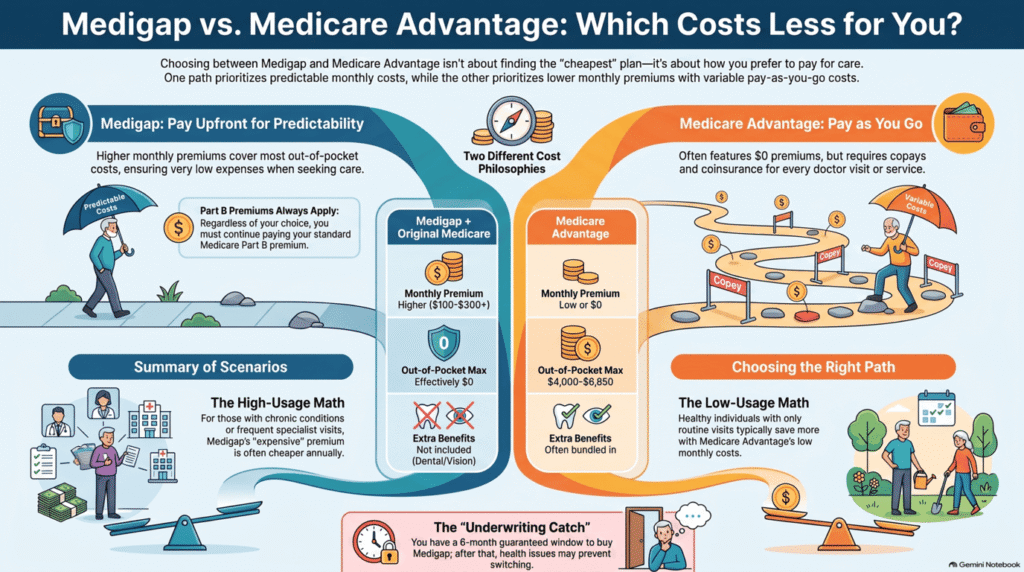
“Which costs less, Medigap or Medicare Advantage?” doesn’t have a single answer—it depends on how much health care you actually use in a given year. The two paths structure costs so differently that comparing premiums alone is misleading. Here’s how to think about it heading into Open Enrollment.
Article Contents
Two Different Cost Philosophies
Medigap (Medicare Supplement Insurance) works alongside Original Medicare. You pay a monthly premium—often the largest single line item in your Medicare budget—and in exchange, most or all of your out-of-pocket costs for doctor visits, hospital stays, and other Medicare-covered services are paid by the Medigap policy. The tradeoff is a higher, predictable monthly cost in exchange for very low costs when you actually need care.
Medicare Advantage flips this structure. Premiums are often low or $0, but you pay copays and coinsurance as you use care, up to an annual out-of-pocket maximum required by CMS. The tradeoff is a lower predictable monthly cost in exchange for variable costs tied to how much care you use.
Side-by-Side Cost Comparison
| Cost Factor | Medigap + Original Medicare + Part D | Medicare Advantage |
|---|---|---|
| Monthly premium | Higher—Medigap premiums commonly range from roughly $100 to $300+ depending on plan letter, state, and age, plus Part B and Part D premiums | Often $0 to modest, plus the standard Part B premium |
| Cost when you use care | Very low to none, depending on the Medigap plan letter | Copays and coinsurance apply per visit or service until you hit the annual max |
| Annual out-of-pocket maximum | Effectively capped near $0 out-of-pocket with a comprehensive Medigap plan | Federally required cap, but typically $4,000–$8,850 depending on the plan |
| Extra benefits (dental, vision, hearing) | Not included; purchased separately | Frequently bundled in |
| Underwriting to enroll later | Guaranteed issue only during specific windows; medical underwriting may apply otherwise | No medical underwriting to enroll during Open Enrollment |
When Medigap Tends to Cost Less Overall
If you have a chronic condition, see specialists frequently, or have had a hospital stay in recent years, the math often favors Medigap despite the higher premium. A single hospitalization under Medicare Advantage can trigger thousands of dollars in copays before you hit the annual out-of-pocket max, while a comprehensive Medigap plan would cover nearly all of that same stay for close to $0 beyond the monthly premium you’re already paying. For people who use care often, the “expensive” premium turns out to be the cheaper path over a full year.
When Medicare Advantage Tends to Cost Less Overall
If you’re generally healthy, see a doctor only for routine visits, and rarely need specialist or hospital care, Medicare Advantage’s low premium can genuinely be the lower-cost option, since you’re not paying for coverage you rarely use. The risk is that your health needs can change unexpectedly—a fall, a new diagnosis, or an unplanned surgery could suddenly put you into copay territory you weren’t budgeting for that year.
Want real numbers instead of ranges? See Medigap and Medicare Advantage premiums quoted for your ZIP code side by side.
The Underwriting Catch With Medigap
This is the detail that trips up the most people. You have a guaranteed issue right to buy any Medigap policy sold in your state, without medical underwriting, during your Medigap Open Enrollment Period—the six months starting the month you’re both 65+ and enrolled in Part B. Outside that window, in most states, insurers can use medical underwriting to deny you a Medigap policy or charge more based on your health history. This matters most for anyone considering starting with Medicare Advantage and “trying Medigap later” — if your health changes in the meantime, you may not be able to switch to Medigap on favorable terms, or at all, depending on your state’s rules. A few states (including New York and Connecticut) have stronger guaranteed issue protections year-round, so it’s worth checking your specific state’s rules.
Practical takeaway: If you’re near your Initial Enrollment Period and think there’s any chance you’ll want Medigap eventually, it’s generally lower-risk to secure it during your guaranteed issue window rather than planning to add it years later.
Medigap Plan Letters and What They Cover
Medigap policies are standardized into lettered plans (A, B, D, G, K, L, M, N, and others, varying slightly by state), each covering a different combination of Medicare’s deductibles, copays, and coinsurance. Plan G and Plan N are among the most commonly chosen for new enrollees, since Plan C and Plan F are no longer available to people who became newly eligible for Medicare on or after January 1, 2020. Every insurer selling “Plan G,” for example, must cover the exact same benefits—the only difference between insurers is the premium and customer service, which makes comparing Medigap largely a price-and-reputation exercise rather than a benefits comparison.
Part D Still Needed Separately With Medigap
Medigap policies don’t include prescription drug coverage. If you go the Original Medicare + Medigap route, you’ll need to separately enroll in a standalone Part D plan—see Medicare Part D Open Enrollment: Comparing Drug Plans for how to compare those.
If frequent doctor visits are part of your year, a Medigap quote might be worth a look before Open Enrollment closes.
A Simple Framework for Deciding
- Estimate your realistic annual usage. Routine visits only, or ongoing specialist care and possible hospitalization?
- Price both paths using your actual usage estimate, not just the sticker premium.
- Check your state’s Medigap guaranteed issue rules if there’s any chance you’d want to add Medigap later.
- Weigh network flexibility. See Medicare Advantage vs. Original Medicare: How to Decide for how much this matters if you travel or split time between states.
- Factor in extra benefits like dental and vision if those are a meaningful part of your budget either way.
Switching Between Them During Open Enrollment
You can move from Medicare Advantage to Original Medicare + Medigap, or vice versa, during AEP (Oct 15 – Dec 7). The Medicare Advantage side of that switch is guaranteed—there’s no underwriting to join a Medicare Advantage plan during Open Enrollment. The Medigap side is where the guaranteed issue rules above come into play, so it’s worth confirming your state’s specific protections before assuming the switch will go through without underwriting.
A Closer Look at Two Household Budgets
Household A: Low Care Usage
Consider someone who sees a primary care doctor twice a year, takes one generic maintenance medication, and hasn’t been hospitalized in over a decade. Their realistic annual medical spending under Medicare Advantage might be a few hundred dollars in copays, well under even a moderate Medigap premium paid monthly for a full year. For this household, Medicare Advantage is very likely the lower-cost path, and the bundled dental and vision benefits are a bonus rather than a factor that changes the decision.
Household B: Ongoing Specialist Care
Now consider someone managing a chronic condition with quarterly specialist visits, several prescriptions, and a hospital stay roughly every other year. Under Medicare Advantage, each specialist visit and hospital stay generates a copay or coinsurance charge, and a single significant hospitalization could push them close to the plan’s annual out-of-pocket maximum. Under Medigap, those same services are largely covered after the monthly premium, making their annual costs far more predictable and, in years with a hospitalization, meaningfully lower overall. For this household, the higher Medigap premium functions less like an extra cost and more like the price of predictability.
Don’t Forget Part B Premiums Apply Either Way
Regardless of which path you choose, the standard Part B premium applies to everyone with Medicare — it isn’t something Medigap or Medicare Advantage replaces. Higher-income beneficiaries also pay an Income-Related Monthly Adjustment Amount (IRMAA) on top of the standard Part B and Part D premiums, which applies the same way under either path. See Medicare Costs in 2027: Premiums, Deductibles, and Limits for the current IRMAA thresholds and standard premium amounts.
The Bottom Line on Cost
Neither Medigap nor Medicare Advantage is objectively cheaper—each shifts cost risk in a different direction. Medigap trades a higher guaranteed monthly cost for near-total protection against unpredictable medical bills. Medicare Advantage trades a lower guaranteed monthly cost for exposure to variable copays that depend entirely on how much care you end up needing that year. The right choice comes down to how much uncertainty you’re comfortable carrying, and how your health has actually trended over the past few years—not just how you feel about your health today.
Revisiting the Decision Every Fall
Because Medigap premiums typically rise with age and Medicare Advantage plan benefits reset annually, the decision that made sense five years ago isn’t guaranteed to still be the best fit. Reviewing both paths during Open Enrollment each year — even if you ultimately stay put — is the only way to know for certain that your current coverage is still the most cost-effective option available to you.
Frequently Asked Questions
Is Medigap more expensive than Medicare Advantage?
Medigap has a higher monthly premium than most Medicare Advantage plans, but often results in lower total costs for people who use frequent or high-cost care, since it covers most out-of-pocket costs Medicare doesn’t. Medicare Advantage usually costs less for people who use minimal care.
Can I switch from Medicare Advantage to Medigap anytime?
You can request a Medigap policy anytime, but outside your Medigap Open Enrollment Period or a guaranteed issue situation, insurers in most states can use medical underwriting to deny coverage or charge more based on your health history
Does Medigap include prescription drug coverage?
No. Medigap policies do not include Part D prescription drug coverage. You need to enroll in a separate standalone Part D plan if you have Original Medicare with a Medigap policy.
What is the Medigap Open Enrollment Period?
It’s a one-time six-month window that starts the month you’re both 65 or older and enrolled in Medicare Part B. During this window, you have a guaranteed issue right to buy any Medigap policy sold in your state without medical underwriting.
Which is better for someone with a chronic health condition, Medigap or Medicare Advantage?
Medigap is often more cost-predictable for people with chronic conditions or frequent specialist and hospital use, since it covers most of the out-of-pocket costs Medicare Advantage would charge as copays and coinsurance.
More in This Medicare Open Enrollment Guide
- Medicare Open Enrollment 2027: The Complete Guide
- Medicare Advantage vs. Original Medicare: How to Decide
- How to Switch Medicare Advantage Plans During Open Enrollment
- Medicare Part D Open Enrollment: Comparing Drug Plans
- Medigap vs. Medicare Advantage: Which Costs Less?
- Medicare Open Enrollment Deadlines and Penalties
- Medicare Advantage Star Ratings Explained
- Medicare Special Enrollment Periods: Do You Qualify?
- Medicare Costs in 2027: Premiums, Deductibles, and Limits
- Medicare Open Enrollment Checklist: 10 Questions to Ask
Not sure your current plan is still your best option?
Compare Medicare Advantage, Part D, and Medigap plans available in your ZIP code before the December 7 deadline.
SeniorAffair.com may earn a commission from partner links above. This does not affect our editorial coverage.
We are not connected with or endorsed by the U.S. government or the federal Medicare program.
© 2026 SeniorAffair.com — A 55+ Lifestyle Digital Magazine.
Information on this page is general in nature and not a substitute for personalized advice from Medicare.gov, 1-800-MEDICARE, or a licensed insurance agent.





[…] Decide between Medigap and Medicare Advantage if you’re considering Original Medicare—the cost tradeoffs vary for everyone. Compare them in Medigap vs. Medicare Advantage: Which Costs Less?. […]