


If you’re on a Medicare Advantage plan, there’s an important question to ask before the 2026 Annual Enrollment Period opens in October: Will your plan still exist in 2027, and if it does, will it still offer the same benefits?
The answer, for a growing number of beneficiaries, is no. Major Medicare Advantage insurers—including CVS/Aetna—have signaled a deliberate shift in strategy for 2027, moving away from aggressive membership growth and toward margin improvement. The driver: a 2.48% average rate increase from CMS that, while higher than initially projected, still fell short of what many insurers needed to sustain the benefits packages they offered in prior years.
The result is a wave of selective market exits, benefit reductions, and premium increases hitting beneficiaries ahead of 2027. Here’s what’s happening, who is most affected, and exactly what you should do before December 7, 2026.
In This Article
- Why Insurers Are Cutting Benefits in 2027
- The 2.48% CMS Rate Increase: What It Means
- Which Insurers Are Making Changes?
- Types of Benefit Changes to Watch For
- How to Find Out If Your Plan Is Affected
- What to Do If Your Plan Is Cutting Benefits or Exiting Your County
- Your Alternatives: Comparing Options for 2027
- Frequently Asked Questions
Why Insurers Are Cutting Benefits in 2027
Medicare Advantage insurers are paid a fixed monthly capitated rate by CMS for each enrollee—adjusted for the enrollee’s age, health status (via a risk score), and geography. The insurer then takes on the financial risk of delivering Medicare benefits plus whatever supplemental extras (dental, vision, flex cards, etc.) they’ve added to attract enrollees.
This model worked well when CMS rates were rising faster than medical costs. But several factors have converged to squeeze insurer margins in recent years:
- Post-pandemic healthcare utilization surge: Patients who deferred care during COVID-19 are now using significantly more medical services, driving up claims costs.
- Risk score accuracy crackdowns: CMS has tightened oversight of how insurers calculate risk scores, reducing some of the favorable adjustments plans had previously used to boost revenue.
- Prior authorization scrutiny: Legislative and regulatory pressure to reduce unnecessary prior authorization denials has increased care delivery costs.
- Rate growth below medical cost inflation: The 2.48% rate increase, while nominally positive, hasn’t kept pace with medical cost trends in many markets.
When the math no longer works in a given county or market, insurers have two choices: reduce benefits to cut costs or exit the market entirely.
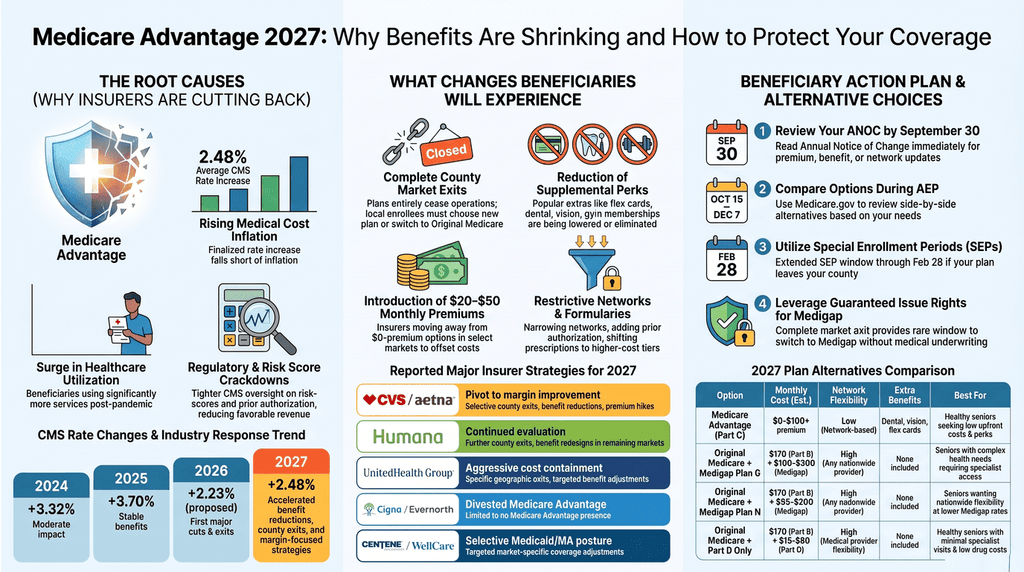
The 2.48% CMS Rate Increase: What It Means for Plans and Beneficiaries
CMS sets Medicare Advantage rates annually through what’s called the “Advance Notice” and “Final Rule” process. For 2027, CMS finalized a 2.48% average rate increase to Medicare Advantage plans—higher than the 2.23% proposed in the Advance Notice, but still below what many analysts estimated plans needed to sustain current benefit packages.
| Plan Year | CMS Average Rate Change | Industry Impact |
|---|---|---|
| 2024 | +3.32% | Moderate—some plans still cut supplemental benefits |
| 2025 | +3.70% | Moderate positive—most plans maintained benefit levels |
| 2026 | +2.23% (proposed) / actual varies | First significant wave of selective exits and benefit reductions |
| 2027 | +2.48% | Continued exits; accelerated benefit trimming; margin-over-membership strategy |
For beneficiaries, the rate increase itself is invisible—what you see is its downstream effect on your plan’s benefits, premiums, network, and continued availability.
Which Insurers Are Making Changes for 2027?
The most significant publicly signaled changes heading into 2027 involve major carriers. Here’s a summary of publicly disclosed or reported changes:
| Insurer | Reported 2027 Strategy | Reported Impact |
|---|---|---|
| CVS/Aetna | Explicit shift from membership growth to margin improvement; plan redesign | Selective county exits; benefit reductions in underperforming markets; premium increases |
| Humana | Previously exited significant MA markets in 2025–2026; continued selective evaluation | Further market exits possible; benefit redesigns in remaining markets |
| UnitedHealth Group | Facing medical cost pressures; cost containment focus | Some benefit adjustments reported; market exits in specific geographies |
| Cigna/Evernorth | Previously divested MA business in 2024; largely exited market | Limited MA presence going forward |
| Centene/WellCare | Medicaid-heavy; MA posture selective | Some market-specific adjustments |
Note: Insurer-specific changes for 2027 will be officially disclosed during the October–December 2026 Annual Enrollment Period through updated plan documents and Medicare.gov. The information above reflects publicly reported insurer strategies as of May 2026 and may change before final plan submissions.
Types of Benefit Changes to Watch For
When a Medicare Advantage plan “cuts benefits,” that can mean many different things. Here are the most common changes beneficiaries experience:
1. Complete Market Exit
The plan stops operating in your county entirely. You will receive a notice—required by CMS—that your plan will be discontinued and that you have a Special Enrollment Period to select a new plan. This is the most disruptive change and affects all enrollees in that county.
2. Reduction of Supplemental Benefits
The plan continues operating but eliminates or reduces extras like the grocery flex card allowance, dental benefit amount, OTC allowance, vision coverage, or gym membership. Your core Medicare coverage continues unchanged, but the perks that attracted you to the plan may disappear.
3. Premium Increases
Many Medicare Advantage plans have offered $0 monthly premiums as a selling point. In 2027, some of these plans are introducing modest monthly premiums ($20–$50/month) to offset costs. While still low compared to Medigap premiums, this breaks the $0 expectation many beneficiaries have built around.
4. Network Narrowing
Your plan may cut specific hospitals, specialist practices, or pharmacy chains from its network. If your preferred doctors or hospital are dropped, your costs for out-of-network care can increase dramatically—or care may simply be unavailable in-network.
5. Prior Authorization Expansion
Plans may add prior authorization requirements for procedures or medications they previously covered without approval, increasing administrative friction for accessing care.
6. Formulary Changes
Drug formularies can change annually. Medications that were on a preferred (lower-cost) tier may move to a higher tier or may be removed from coverage entirely, requiring a formulary exception.
How to Find Out If Your Plan Is Affected
CMS requires Medicare Advantage plans to notify affected members of material benefit changes. Here’s how and when you’ll find out:
- Annual Notice of Change (ANOC): Your plan must send you this document by September 30 each year. It details all changes to your plan taking effect January 1 of the following year. Read it carefully—don’t let it sit unopened.
- Evidence of Coverage (EOC): The full detailed plan document for the upcoming year, typically available in October. Compare your 2026 EOC to your 2027 EOC for changes.
- Medicare.gov Plan Finder: Updated with 2027 plan data before AEP opens October 15. Enter your zip code, current doctors, and medications to see all available plans and compare benefits side-by-side.
- Direct call to your plan: Call the member services number on your plan card and ask directly, “Will this plan be available in my county in 2027?” and “What changes are being made to benefits, network, and premiums?”
Don’t wait for the mail. Plans are required to send benefit change notices, but mail gets lost and seniors are sometimes not at their primary address during the September mailing. Proactively check Medicare.gov and call your plan in October rather than assuming nothing changed.
What to Do If Your Plan Is Cutting Benefits or Exiting Your County
If Your Plan Is Exiting Your County
- You will receive a Special Enrollment Period (SEP) allowing you to switch plans outside the normal AEP window. You typically have until February 28 of the effective year to select a new plan.
- Do not assume you will automatically be enrolled in another plan. You must actively choose a replacement. If you take no action, CMS may assign you to a default plan, which may not be optimal for your needs.
- Use this as an opportunity to compare all available options—including Original Medicare plus a Medigap policy—not just other Medicare Advantage plans.
If Your Plan Is Trimming Benefits
- Compare the value of the reduced plan versus competing Medicare Advantage plans in your area on Medicare.gov during AEP.
- Calculate the actual dollar impact of the benefit change—a lost $75/month grocery card is $900/year of real value. Determine whether a competing plan with better benefits justifies switching, even at a slightly higher premium.
- Check whether your current doctors and preferred pharmacy remain in-network under any plan you’re considering switching to.
Your Alternatives: Comparing Options for 2027
| Option | Monthly Cost (Est.) | Flexibility | Extra Benefits | Best For |
|---|---|---|---|---|
| Medicare Advantage (Part C) | $0–$100+ premium; $0–$8,500 MOOP | Low—network-based | Dental, vision, flex cards, fitness | Healthy seniors who want low upfront costs and perks |
| Original Medicare + Medigap Plan G | $170 (Part B) + $100–$300 (Medigap) | High—any Medicare provider nationwide | None included; pure cost coverage | Seniors with complex health needs: specialist access essential |
| Original Medicare + Medigap Plan N | $170 (Part B) + $80–$200 (Medigap) | High—any Medicare provider nationwide | None included | Seniors wanting network flexibility at a lower Medigap premium |
| Original Medicare + Part D only | $170 (Part B) + $15–$80 (Part D) | High for medical; national pharmacy networks | None | Seniors in good health with minimal specialist needs and low drug costs |
Cost estimates as of 2026. Individual costs vary significantly by plan, location, age, and health history. Medigap is subject to medical underwriting outside Open Enrollment windows in most states.
The Medigap Timing Warning: If your Medicare Advantage plan exits your market and you want to switch to Medigap, you have guaranteed issue rights during your SEP—meaning insurers cannot deny coverage or charge more based on your health history. Outside of guaranteed issue windows, Medigap applicants in most states must pass medical underwriting. If a plan exit gives you a guaranteed issue window, this may be your best opportunity to move to Original Medicare with Medigap protection.
Frequently Asked Questions
Why are Medicare Advantage plans cutting benefits in 2027?
Medicare Advantage plans are cutting benefits in 2027 primarily because a 2.48% average rate increase from CMS has not kept pace with rising healthcare utilization and medical costs. Major insurers, including CVS/Aetna, have explicitly stated they are prioritizing profit margins over membership growth for the 2027 contract year. This has led to selective exits from unprofitable geographic markets, elimination of supplemental benefits like grocery allowances and OTC cards, and premium increases for some previously $0-premium plans.
How do I find out if my Medicare Advantage plan is leaving my area in 2027?
Your plan is required to send you an Annual Notice of Change (ANOC) by September 30, 2026, detailing any changes to your plan for 2027. If your plan is exiting your county, you will receive direct notification. You can also proactively check Medicare.gov’s Plan Finder tool starting in October 2026, call your plan’s member services number, or contact your State Health Insurance Assistance Program (SHIP) for free, unbiased guidance on your options.
What happens if my Medicare Advantage plan exits my county?
If your Medicare Advantage plan exits your county, you will receive a Special Enrollment Period (SEP) giving you the right to enroll in a new plan outside the normal Annual Enrollment Period window. You typically have until February 28 of the next plan year to select a replacement. If you take no action, CMS may assign you to a default plan. You should use the SEP to actively compare all available options, including other Medicare Advantage plans, Original Medicare with a Medigap supplement, and Original Medicare with Part D drug coverage.
Is Aetna Medicare Advantage leaving certain areas in 2027?
CVS/Aetna has publicly signaled a strategic shift for 2027 from membership growth to margin improvement, which analysts and insurers have indicated will include selective exits from specific counties and markets. The full scope of Aetna’s 2027 geographic footprint will be officially disclosed through CMS plan filings and beneficiary notices before and during the Annual Enrollment Period (October 15–December 7, 2026). If you are on an Aetna Medicare Advantage plan, watch for your Annual Notice of Change in late September 2026 and verify your plan’s 2027 status on Medicare.gov during AEP.
Should I switch from Medicare Advantage to Original Medicare with Medigap?
Whether to switch from Medicare Advantage to Original Medicare with Medigap depends on your personal health needs, financial situation, and geography. Original Medicare with a Medigap supplement offers broader provider access (any Medicare-accepting doctor nationally), more predictable costs, and no network restrictions — but typically costs more in monthly premiums. Medicare Advantage may offer lower monthly costs and supplemental extras, but restricts you to a plan network and has an annual maximum out-of-pocket exposure. If your Medicare Advantage plan is exiting your market, your guaranteed issue period is one of the few times you can switch to Medigap without medical underwriting — making it worth careful consideration.
The Bottom Line
The 2027 Medicare Advantage landscape is the most turbulent it’s been in years. If you’re on a Medicare Advantage plan, the best thing you can do is not assume your plan will be the same in 2027. Watch for your Annual Notice of Change in late September 2026. Compare your options actively during AEP — don’t auto-renew without reviewing. And if your plan exits your county, treat the Special Enrollment Period as an opportunity to reassess your entire Medicare strategy, not just a scramble to pick any available plan. Your health coverage deserves an annual review, and 2027 makes that review more important than ever.






In the chart showing insurers who are making changes for 2027 I was surprised that ConnectiCare was not included. Why not?
Thanks for your comment; the list is not inclusive and may include other insurers that we aren’t aware of.