


Home Blog Page 4

How to Switch Medicare Advantage Plans During Open Enrollment

0
How to Switch Medicare Advantage Plans During Open Enrollment

Step-by-step instructions for switching Medicare Advantage plans during the Annual Enrollment Period, including deadlines, documents, and common mistakes.

By the SeniorAffair.com Medicare Team · Reviewed for accuracy against CMS.gov and Medicare.gov

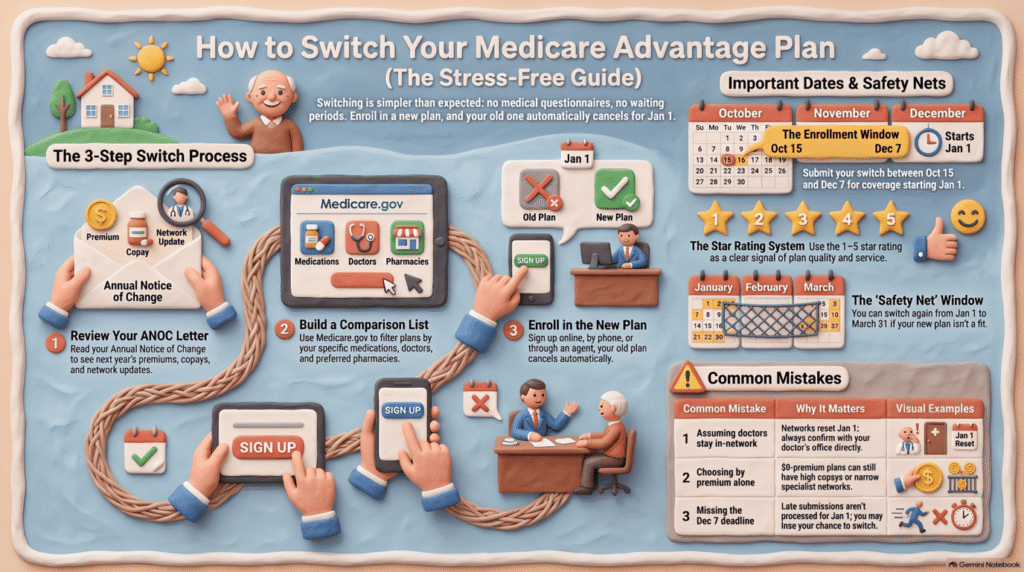
Switching Medicare Advantage plans is more straightforward than most people expect—there’s no application to be denied, no medical questionnaire, and no waiting period. If you’re enrolled in a Medicare Advantage plan and want a different one for 2027, here’s exactly how the process works during Open Enrollment (Oct 15–Dec 7, 2026).

Common Reasons People Switch Medicare Advantage Plans

  • Their doctor or preferred hospital left the plan’s network
  • A prescription moved to a higher (more expensive) drug tier or was dropped from the formulary
  • The premium, deductible, or copays increased in the plan’s Annual Notice of Change letter
  • The plan’s star rating dropped, signaling declining customer service or care quality
  • They moved to a new county or state where the plan isn’t offered, or a better plan became available
  • They want additional supplemental benefits, like dental or transportation, not offered in their current plan

Step 1: Confirm What’s Changing in Your Current Plan

Start with your Annual Notice of Change (ANOC) letter, mailed by your plan by September 30. It spells out next year’s premium, deductible, copays, and any changes to the provider network or drug formulary. This is the document that tells you whether switching is worth the effort at all—sometimes a plan’s changes are minor, and staying put is the simplest choice.

Step 2: Build Your Comparison List

Before comparing plans, gather:

  • Your current prescriptions, with exact dosages
  • A list of the doctors, specialists, and hospitals you use regularly
  • Your preferred pharmacy
  • An honest estimate of how often you expect to need care next year

Then use Medicare.gov’s Plan Finder tool (or a licensed agent) to see every Medicare Advantage plan available in your ZIP code, filtered by your medications and providers. Pay attention to the plan’s star rating, since it’s one of the clearest available signals of plan quality.

Step 3: Enroll in the New Plan

This is the part that surprises people: you do not need to cancel your old plan first. When you enroll in a new Medicare Advantage plan, it automatically cancels your enrollment in the old one, effective the same date the new plan starts. You can enroll:

  • Online at Medicare.gov using your Medicare number
  • By phone by calling 1-800-MEDICARE (available 24/7)
  • Directly through the new plan’s website or a licensed agent who can submit the enrollment on your behalf
  • By mail using a paper enrollment form from the new plan

Ready to compare alternatives before you commit to a switch? See every Medicare Advantage plan available in your ZIP code.

See My Options →

Step 4: Confirm Your Effective Date

Any switch made during AEP (Oct 15–Dec 7) takes effect January 1, 2027, regardless of the exact date you submitted it within that window. You should receive a confirmation letter and a new member ID card from the new plan before the end of December. If you haven’t received your card by early January, call the new plan directly to confirm your enrollment went through.

What Happens to Your Old Plan

Your old Medicare Advantage plan coverage ends automatically on December 31, and your new plan’s coverage begins January 1. You do not need to send a cancellation notice to your old plan—the enrollment system handles it for you once the new plan processes your application. One exception: if you’re switching for reasons related to unpaid premiums or a plan-initiated disenrollment, contact the plan directly, since that process works differently.

Common Mistakes When Switching

MistakeWhy It Matters
Assuming your doctor is in-network based on last year’s cardNetworks reset every January 1; confirm directly with the provider’s office for the new plan year
Switching based on premium aloneA $0-premium plan can still have high copays, prior authorization requirements, or a narrow specialist network
Enrolling twice in different plansThe most recent enrollment submitted before Dec 7 is the one that takes effect—double-enrolling can create confusion, not extra coverage
Missing the Dec 7 deadline by a few daysLate submissions aren’t processed for a Jan 1 effective date; you may have to wait for the Medicare Advantage Open Enrollment Period in January–March instead
Not checking the drug formulary tier-by-tierA drug can be “covered” but placed in a high-cost tier, dramatically changing your actual copay

For a full rundown of what happens after a missed deadline, see Medicare Open Enrollment Deadlines and Penalties.

Switching to Original Medicare Instead

If you decide you’d rather leave Medicare Advantage altogether and return to Original Medicare, the same enrollment window applies. You’ll want to also enroll in a standalone Part D plan (see Medicare Part D Open Enrollment: Comparing Drug Plans) and consider whether you can add a Medigap policy, since your guaranteed issue rights for Medigap outside your initial enrollment window vary by state—covered in Medigap vs. Medicare Advantage: Which Costs Less?.

What If You Want to Switch Again in Early 2027?

If your new plan turns out not to be a good fit once you start using it, you’re not completely stuck until next fall. The Medicare Advantage Open Enrollment Period runs January 1–March 31 and allows one additional switch to a different Medicare Advantage plan or a return to Original Medicare with a Part D plan. It’s a narrower window than AEP—you can’t switch standalone Part D plans without also being in Medicare Advantage—but it exists as a safety net for exactly this situation.

A Simple Pre-Enrollment Checklist

  1. Read your ANOC letter for next year’s changes
  2. List your medications, doctors, and pharmacy
  3. Compare at least 2–3 plans on Medicare.gov’s Plan Finder
  4. Check each plan’s star rating
  5. Confirm total estimated annual cost, not just premium
  6. Enroll online, by phone, or through an agent before December 7
  7. Confirm your new member ID card arrives before January 1

Want a shortlist before you call an agent? Filter Medicare Advantage plans by your prescriptions and doctors in minutes.

Build My Shortlist →

Working With a Licensed Agent vs. Doing It Yourself

Both paths work, and neither costs you extra—licensed agents are paid by the insurance carrier, not by you, so using one doesn’t raise your premium. A licensed independent agent who represents multiple carriers can run side-by-side comparisons faster than browsing Medicare.gov alone and can flag network or formulary issues you might miss. The tradeoff is that an agent tied to a single carrier will only show you that company’s plans, so it’s worth asking upfront whether the agent is independent or captive to one insurer. If you’d rather compare on your own first and bring questions to an agent afterward, that’s a perfectly reasonable approach too—Medicare.gov’s Plan Finder tool is built for public, self-service use.
How to Switch Health Plans

Switching for a Specific Reason: Three Scenarios

“My doctor left the network”

Search Plan Finder using your specialist’s name directly, not just general network descriptions, since some plans include a specialist for certain procedures but not others. If the same doctor is in-network for multiple plans, compare those plans’ drug formularies and copay structures to narrow down the choice.

“My premium and copays went up in the ANOC letter”

Compare the new total annual cost estimate (premium plus expected copays based on last year’s usage) against at least two alternative plans in your area. Sometimes the increase is roughly matched across most local plans because it reflects a regional cost trend rather than something specific to your plan—worth confirming before assuming a switch will save money.

“I want dental or vision coverage I don’t currently have”

Not all supplemental benefits are equal. Compare the actual dollar allowance and annual maximum for dental work, not just whether a plan advertises “dental coverage included.” Some plans cap preventive cleanings at two per year with no coverage for major work like crowns or root canals, while others include a meaningful allowance toward major procedures.

How Plan Finder Displays Your Options

When you search Medicare.gov’s Plan Finder with your medications and providers entered, it returns a ranked list showing each plan’s estimated total annual cost, monthly premium, deductible, and whether your specific doctors and drugs are covered. It also displays each plan’s star rating and a direct link to the plan’s Evidence of Coverage document, which is the legally binding description of exactly what’s covered. Reading at least the summary of benefits section of the Evidence of Coverage—not just the marketing brochure—is the single best way to avoid a mid-year coverage surprise.

After You Enroll: What to Expect Next

Once your enrollment is processed, you’ll typically receive a confirmation letter within a couple of weeks, followed by your new member ID card closer to the January 1 effective date. Keep both your old and new ID cards through the transition—you may need your old plan’s information for any claims from care received before December 31. If you don’t receive confirmation within a few weeks of enrolling, don’t assume it went through silently; call the new plan directly or 1-800-MEDICARE to verify your application was received and processed correctly before the deadline passes.

Frequently Asked Questions

Do I need to cancel my old Medicare Advantage plan before switching?

No. Enrolling in a new Medicare Advantage plan automatically cancels your enrollment in the old one, effective the date the new plan’s coverage begins.

How long does it take for a Medicare Advantage plan switch to take effect?

Switches made during the Annual Enrollment Period (Oct 15 – Dec 7) all take effect on January 1 of the following year, regardless of when during that window you submit the change.

Can I switch Medicare Advantage plans more than once a year?

You can switch during the Annual Enrollment Period (Oct 15 – Dec 7), and if you’re already in a Medicare Advantage plan, you get one additional switch during the Medicare Advantage Open Enrollment Period (Jan 1 – Mar 31).

What documents do I need to switch Medicare Advantage plans?

You’ll need your Medicare number, a list of your current prescriptions with dosages, and the names of the doctors and hospitals you use. No medical questionnaire or health screening is required to switch Medicare Advantage plans.

What happens if I miss the December 7 deadline?

If you miss the deadline and you’re already in Medicare Advantage, you can still make one change during the Medicare Advantage Open Enrollment Period from January 1 to March 31. Otherwise you may need to qualify for a Special Enrollment Period or wait until the next Annual Enrollment Period.

More in This Medicare Open Enrollment Guide

Not sure your current plan is still your best option?

Compare Medicare Advantage, Part D, and Medigap plans available in your ZIP code before the December 7 deadline.

Compare Medicare Plans →

SeniorAffair.com may earn a commission from partner links above. This does not affect our editorial coverage.

We are not connected with or endorsed by the U.S. government or the federal Medicare program.

© 2026 SeniorAffair.com—A 55+ Lifestyle Digital Magazine. Information on this page is general in nature and not a substitute for personalized advice from Medicare.gov, 1-800-MEDICARE, or a licensed insurance agent.

Medicare Open Enrollment Deadlines and Penalties

0
Medicare Open Enrollment Deadlines and Penalties

What happens if you miss the December 7 Medicare Open Enrollment deadline, plus how Part B and Part D late enrollment penalties are calculated.

By the SeniorAffair.com Medicare Team · Reviewed for accuracy against CMS.gov and Medicare.gov

Medicare runs on strict deadlines, and missing one can mean waiting months to fix a coverage gap—or paying a penalty that follows you for as long as you have Medicare. Here’s what actually happens if you miss Open Enrollment (Oct 15–Dec 7, 2026), plus how the Part B and Part D late enrollment penalties are calculated.

The Core Deadline: December 7

Any change you want to make to your Medicare Advantage or Part D coverage for the 2027 plan year must be submitted by December 7, 2026. Submissions are based on the date they’re received, not postmarked, so mailing a paper form on December 6 without accounting for delivery time is a common way people accidentally miss the window.

What Happens If You Miss AEP

Your SituationWhat You Can Still Do
Currently in Medicare AdvantageWait for the Medicare Advantage Open Enrollment Period, Jan 1–Mar 31, for one additional switch or a return to Original Medicare
Currently in Original Medicare with a standalone Part D planNo general fallback window—you’ll likely need to wait until next year’s AEP unless you qualify for a Special Enrollment Period
Never enrolled in Part BEnroll during the General Enrollment Period, Jan 1–Mar 31, with coverage starting the month after you enroll; a late enrollment penalty may apply
Experienced a qualifying life eventMay be eligible for a Special Enrollment Period regardless of the AEP deadline—see Medicare Special Enrollment Periods: Do You Qualify?

The Part B Late Enrollment Penalty

If you don’t sign up for Part B when you’re first eligible (and don’t qualify for a Special Enrollment Period, such as still having employer coverage), your monthly Part B premium can go up 10% for each full 12-month period you were eligible but didn’t enroll. Unlike some penalties, this one is permanent—it applies for as long as you have Part B, not just for a year or two.

Example: If you were eligible for Part B for 24 months before enrolling, your premium would be about 20% higher than the standard premium for as long as you’re enrolled in Part B.

The Part D Late Enrollment Penalty

If you go 63 or more consecutive days without Part D or other “creditable” prescription drug coverage (coverage at least as good as standard Part D) after your Initial Enrollment Period ends, you may owe a Part D late enrollment penalty. It’s calculated as roughly 1% of the national base beneficiary premium for each full month you went without creditable coverage, added to your monthly Part D premium—again, permanently, for as long as you have Part D coverage.

Example: Going 24 months without creditable drug coverage would add roughly 24% of the national base beneficiary premium to your monthly Part D premium indefinitely.

If you had prescription drug coverage through an employer, union, or other source that was at least as good as Part D (creditable coverage), you generally won’t owe this penalty as long as you enroll in Part D within 63 days of losing that coverage.

How to Avoid Late Enrollment Penalties

  • Enroll in Part B during your Initial Enrollment Period unless you have qualifying employer coverage
  • Enroll in a Part D plan (standalone or through Medicare Advantage) as soon as you’re eligible, even if you don’t take many prescriptions currently
  • If you have employer or union drug coverage, confirm in writing that it’s considered “creditable” so you can prove it later if needed
  • If you lose employer coverage, enroll in Part D within 63 days to avoid a penalty

What If You Made a Mistake During AEP?

If you submitted an enrollment change during AEP and realize afterward it was the wrong choice, you generally cannot reverse it once the window closes on December 7—except through the Medicare Advantage Open Enrollment Period in January–March if you’re in a Medicare Advantage plan, or by qualifying for a Special Enrollment Period. This is one reason it’s worth starting your Open Enrollment review in October rather than making a rushed decision on December 6. For a step-by-step approach to reviewing plans with enough lead time, see Medicare Open Enrollment Checklist: 10 Questions to Ask.

Deadlines That Aren’t AEP

DeadlineWhat It’s For
7 months around your 65th birthdayInitial Enrollment Period for Part A and Part B
63 days after losing creditable drug coverageEnroll in Part D to avoid the late enrollment penalty
September 30Deadline for plans to mail Annual Notice of Change (ANOC) letters
December 7Last day to submit an AEP change for a January 1 effective date
March 31End of both the General Enrollment Period and the Medicare Advantage Open Enrollment Period

How Late Enrollment Penalties Interact With Star Ratings and Special Enrollment

Some Special Enrollment Periods, such as moving out of your plan’s service area or qualifying for Extra Help, allow you to enroll without triggering a late enrollment penalty even outside AEP. Additionally, if you’re eligible to join a 5-star Medicare Advantage or Part D plan, a special year-round enrollment window applies—see Medicare Advantage Star Ratings Explained and Medicare Special Enrollment Periods: Do You Qualify? for details on both.

If You’re Not Sure Whether You Owe a Penalty

Social Security (for Part B) or your Part D plan (for Part D) will notify you in writing if a late enrollment penalty applies and show you the calculation. If you believe the penalty was calculated incorrectly—for example, if you had creditable employer coverage that wasn’t accounted for — you can request a formal reconsideration and submit proof of your prior coverage.

Why the December 7 Deadline Is Firm

Unlike some administrative deadlines that have informal grace periods, Medicare’s plan enrollment systems are built around fixed processing windows tied directly to the January 1 effective date. Insurers need time between December 7 and January 1 to process enrollment files, issue new member ID cards, and update pharmacy and provider systems. There’s no practical mechanism for a late submission to still take effect January 1, which is why “I meant to do it” isn’t something Medicare can retroactively fix—the systems simply aren’t built to accommodate it.

Common Ways People Accidentally Miss the Deadline

  • Mailing a paper enrollment form too close to the deadline. Postal delivery time isn’t factored in—the plan needs to receive it by December 7, not postmark it.
  • Assuming a phone call “locked in” a change that was never actually processed. Always ask for a confirmation number and follow up in writing if possible.
  • Confusing AEP with the Medicare Advantage Open Enrollment Period. The January–March window is narrower and doesn’t allow switching standalone Part D plans independently.
  • Waiting on a decision from a family member who needs to review the options together, and running out the clock in the process.

What to Do If You Realize You’re About to Miss It

If you’re within the final days of AEP and haven’t made a decision, the safest move is to make your best available choice using Medicare.gov’s Plan Finder rather than let the deadline pass entirely. You generally can submit and then still change your mind again before December 7 if a later submission supersedes an earlier one within the same window—confirm this directly with Medicare.gov or 1-800-MEDICARE if you’re unsure, since it’s better to lock in an imperfect improvement than to default into another full year of a plan that no longer fits your needs.

Penalties vs. Coverage Gaps: Two Different Risks

It’s worth separating two distinct risks that people sometimes conflate. A late enrollment penalty is a permanent premium surcharge for delaying enrollment in Part B or Part D beyond your window. A coverage gap is a period where you simply have no active Medicare Advantage or Part D plan at all, which can happen if a plan is discontinued and you don’t select a new one in time. Both are avoidable with the same basic discipline: track your deadlines, respond to plan notices promptly, and don’t assume silence from Medicare means everything is fine by default.

The wider picture ties directly back to the questions covered in the main Open Enrollment guide: know your dates, understand what you’re allowed to change, and build in enough time before December 7 that a missed mail delivery or a busy week doesn’t turn into a full extra year on a plan that no longer serves you well.

Frequently Asked Questions

What happens if I miss the December 7 Medicare Open Enrollment deadline?

If you’re in Medicare Advantage, you can still make one change during the Medicare Advantage Open Enrollment Period from January 1 to March 31. If you’re in Original Medicare with a standalone Part D plan, you generally have to wait until the next Annual Enrollment Period unless you qualify for a Special Enrollment Period.

How much is the Medicare Part B late enrollment penalty?

The Part B penalty adds roughly 10% to your monthly premium for each full 12-month period you were eligible for Part B but didn’t enroll, and it applies permanently for as long as you have Part B.

How is the Part D late enrollment penalty calculated?

It’s approximately 1% of the national base beneficiary premium for each full month you went without creditable prescription drug coverage after your Initial Enrollment Period, added permanently to your monthly Part D premium.

Can I avoid the Part D penalty if I have employer drug coverage?

Yes, as long as your employer or union coverage is considered ‘creditable’ (at least as good as standard Part D), you won’t owe a penalty as long as you enroll in Part D within 63 days of losing that coverage.

Is the Medicare late enrollment penalty permanent?

Yes. Both the Part B and Part D late enrollment penalties are generally permanent additions to your monthly premium for as long as you’re enrolled in that part of Medicare, unless you successfully appeal the penalty.

More in This Medicare Open Enrollment Guide

Not sure your current plan is still your best option?

Compare Medicare Advantage, Part D, and Medigap plans available in your ZIP code before the December 7 deadline.

Compare Medicare Plans →

SeniorAffair.com may earn a commission from partner links above. This does not affect our editorial coverage.

We are not connected with or endorsed by the U.S. government or the federal Medicare program.

© 2026 SeniorAffair.com — A 55+ Lifestyle Digital Magazine.

Information on this page is general in nature and not a substitute for personalized advice from Medicare.gov, 1-800-MEDICARE, or a licensed insurance agent.
MedMassager Body Massager Plus Review: The Ultimate Relief for the 55+ Crowd

0
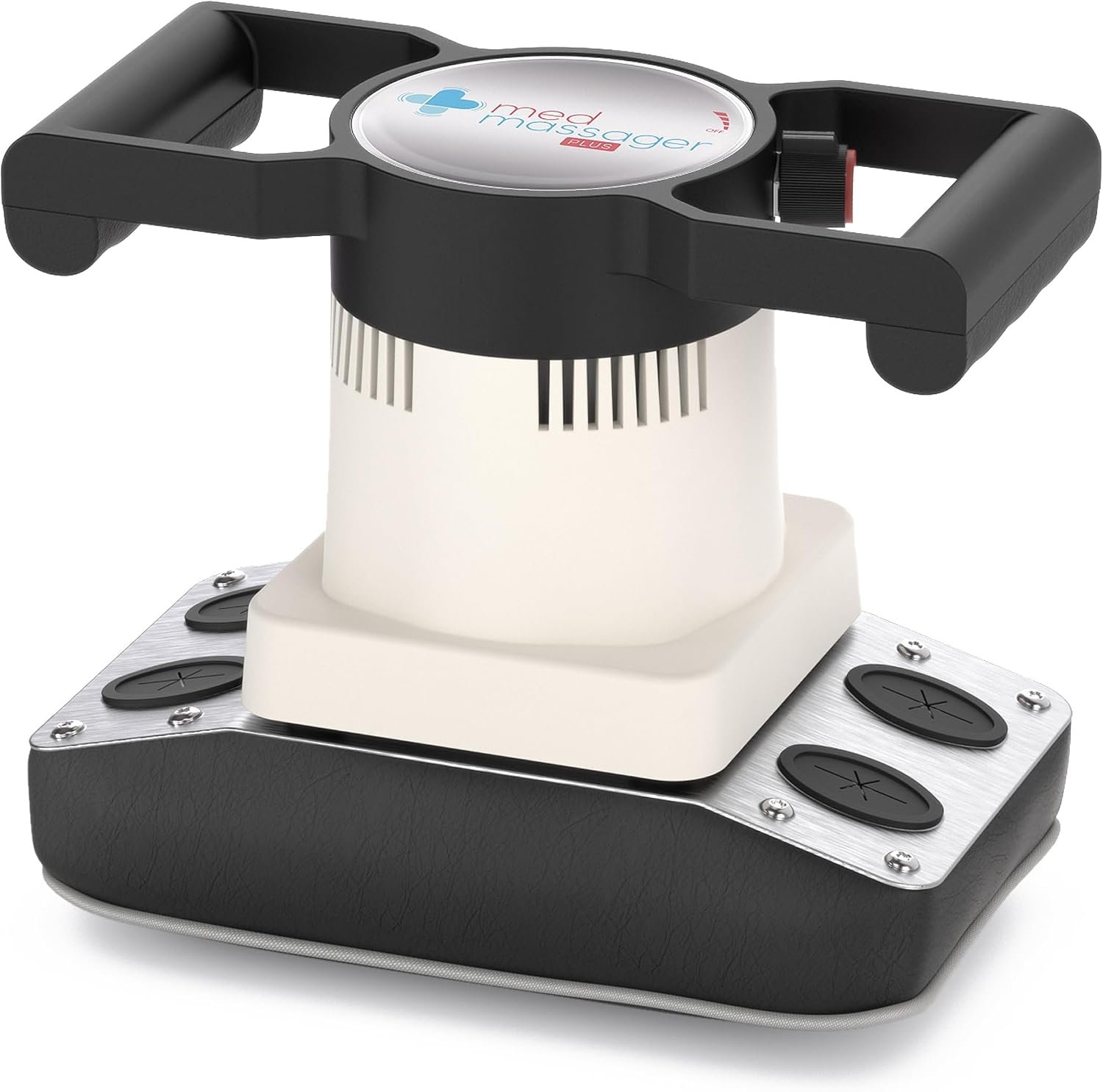
MedMassager Body Massager Plus.
The MedMassager Body Massager Plus. Source: MedMassager

As we embrace life over 55, prioritizing our comfort and mobility becomes absolutely essential. Whether you spend your days gardening, keeping up with the grandkids, or simply relaxing, everyday aches and muscle tension shouldn’t hold you back.

Here at Senior Affair Magazine, we are constantly on the lookout for tools that genuinely improve daily living. Today, we are putting the spotlight on a device that has been making waves in the wellness space: the MedMassager Body Massager Plus.

Shop Med Massager Products 👉

We don’t just read the spec sheets; we put products to the test. Our own Greg Wilson recently took the MedMassager Body Massager Plus for a spin to see if it lives up to the hype.

Greg focused on his most stubborn problem areas: his neck, back, and shoulders. His verdict? He absolutely loved the power.

Unlike flimsy, battery-operated massage wands that stall when you apply pressure, the MedMassager delivers a deep, robust, and consistent oscillation. Greg noted that the dual-handle design made it incredibly easy to maneuver, allowing him to target the tight knots in his shoulders and lower back without straining his arms or wrists.

MedMassager Body Massager Plus Review The Ultimate Relief for the 55 Crowd

Why It Stands Out for Seniors

This isn’t your average department store gadget. Designed with input from physical therapists, the MedMassager is built for serious, therapeutic relief. Here is what makes it a standout choice for anyone aged 55 and up:

  • Unmatched Variable Power: The device features an infinitely variable speed control, ranging from a gentle 400 RPM up to an incredibly powerful 4,000 RPM. You can easily dial it down for sensitive, arthritic areas or crank it up for deep tissue relief.
  • Stimulates Circulation: As we age, maintaining healthy blood flow is crucial. The intense oscillating action of this massager is specifically designed to help stimulate circulation, easing stiffness and promoting healing.
  • Ergonomic & Accessible: You don’t need the grip strength of a bodybuilder to use it. The large, comfortable dual handles allow you to rest the pad against your body effortlessly, making it comfortable for long, relaxing sessions.
  • Full-Body Versatility: While Greg loved it for his upper body, the flat-pad design means it works wonders on tired calves, sore thighs, and achy hips.

The Senior Affair Verdict

Finding a massager that offers genuine, clinical-grade power in a user-friendly package is rare. The MedMassager Body Massager Plus bridges the gap between professional physical therapy equipment and at-home convenience.

You don’t realize how weak battery-operated wands are until you feel the deep, consistent oscillation of the MedMassager. It was incredibly easy to maneuver across my back and shoulders, and the relief was instant. I absolutely love it.

— Greg Wilson, Senior Affair Magazine

Because of its phenomenal power, ease of use, and Greg Wilson’s glowing personal experience, we fully recommend this product to our readers at Senior Affair Magazine. If you are looking for a reliable way to manage daily aches, improve circulation, and reclaim your comfort, this is an investment in your well-being that is entirely worth making.

Shop Med Massager Products 👉

Liingo Eyewear Review 2026: Stylish Prescription Glasses Online — Without Leaving Home

There’s no rule that says glasses after 60 have to be boring or overpriced. Yet walk into a typical optical boutique and you’ll find frames pushing $300 before the lenses are even cut. Liingo Eyewear flips that experience: you try frames from home, order online, and progressive lenses that would cost a fortune at the mall that arrive at a price that doesn’t require a deep breath first.

Here’s our full look at how Liingo works, what it costs, and whether ordering progressive glasses online is actually safe for your prescription.

See frames on your own face—from your sofa

Browse Liingo Frames →

Affiliate link — we may earn a commission at no extra cost to you.

What Is Liingo Eyewear?

Liingo is an online eyewear retailer offering prescription glasses, sunglasses, and blue-light lenses with a try-before-you-buy twist. Its virtual try-on tool lets you preview frames on a photo of your own face, and its home try-on program ships sample frames so you can test fit and style in real life before committing. Lenses are cut to your prescription — including progressives — and shipped to your door.

Key Features Worth Knowing

1. Home Try-On Program

Pick several frames, wear them around the house for a few days, then order your favorite with your prescription. This solves the single biggest worry about buying glasses online: “What if they look terrible on me?”

2. Progressive Lenses at Online Prices

Progressives—the no-line successor to bifocals most of us need after 50—are where optical shops make their margin. Ordering them online typically saves $100–$300 a pair.

3. Virtual Try-On

Upload a photo and see each frame on your face instantly. The tool is simple enough that you won’t need a grandchild’s tech support (though they may enjoy weighing in on the styles).

4. All-Inclusive Lens Packages

Anti-scratch and anti-reflective coatings are included rather than nickel-and-dimed as add-ons—a refreshing change from the optical-chain upsell gauntlet.

Why It Works for Adults 55+

Most of us at this stage own more than one prescription pair: everyday progressives, prescription sunglasses for driving, and maybe computer glasses for the desk. At boutique prices, that wardrobe costs over a thousand dollars. At Liingo’s prices, it’s attainable — and you can update styles when fashion (or your prescription) changes rather than stretching one tired pair for five years.

The home try-on model also removes the rushed, fluorescent-lit showroom decision. You choose frames in your own lighting, at your own pace, with a second opinion from whoever’s at the kitchen table.

Pros and Cons

ProsCons
Try frames at home before buyingYou need a current written prescription, including pupillary distance (PD)
Progressives cost far less than optical-shop pricingComplex prescriptions (prism, very high powers) may still be better fitted in person
Coatings included, not upsoldNo in-person adjustments—though any local optical shop can tweak fit cheaply
Modern, current frame stylesFrame selection smaller than mega-retailers like Zenni

Pricing and Value

Single-vision pairs start at prices comparable to a nice dinner out, with progressives adding a reasonable premium—still typically half (or less) of what a brick-and-mortar optical chain charges for an equivalent pair. Liingo also accepts FSA/HSA payments, and many vision plans reimburse online purchases if you submit an itemized receipt.

Your next pair shouldn’t cost $400

Start a Home Try-On →

Affiliate link — we may earn a commission at no extra cost to you.

Frequently Asked Questions

Can I really order progressive lenses online?

Yes, as long as you have a complete, current prescription. Millions of progressives are sold online every year. If your prescription includes prism correction or unusually high powers, ask your eye doctor whether online ordering makes sense for you.

How do I find my pupillary distance?

Ask your eye doctor to include PD on your prescription (you’re entitled to it), or use Liingo’s at-home measuring guide. It takes about a minute.

What if the glasses don’t feel right?

Liingo offers a return/exchange window on prescription orders — check the current policy at checkout. Minor fit adjustments can be done at most local optical shops for little or nothing.

Does Liingo work with vision insurance?

Most customers pay out of pocket (the prices make that painless) and submit receipts for out-of-network reimbursement where their plan allows. FSA/HSA cards are accepted.

Our Verdict

4.3 / 5 — The smart way to buy your second (and third) pair. Liingo combines genuinely useful try-at-home tools with honest pricing on the lenses people over 50 actually need. Keep your optometrist for the eye exam; let Liingo handle the eyewear bill.

New glasses, no showroom pressure

Shop Liingo Eyewear →

Affiliate link — we may earn a commission at no extra cost to you.

Disclosure: SeniorAffair.com participates in affiliate programs. If you purchase through links on this page, we may earn a commission at no additional cost to you. This article is informational and not medical advice—keep up with regular comprehensive eye exams.

Lenses for Less Review 2026: Are Discount Contact Lenses Worth It After 55?

Contact lenses are one of those recurring expenses that quietly drain a retirement budget. Between multifocal lenses for presbyopia, toric lenses for astigmatism, and the eye-watering markups at some optical chains, a year’s supply can easily top $700. Lenses for Less built its entire business on one promise: the same name-brand lenses your eye doctor prescribes, at prices that respect your budget.

We took a close look at how the retailer works, what it actually saves you, and the fine print to know before you order.

Have your prescription handy?

Compare Your Lens Price Now →

Affiliate link — we may earn a commission at no extra cost to you.

What is Lenses for Less?

Lenses for Less is an online contact lens retailer that sells the major brands—Acuvue, Biofinity, Air Optix, Dailies, Bausch + Lomb, and more—at discounted prices. You order using your existing, valid prescription, and the lenses ship to your door. There’s no subscription gimmick and no house-brand bait-and-switch: these are the identical, factory-sealed lenses you’d get at the optometrist, minus the office markup.

How It Works

  • Step 1: Get or renew your contact lens prescription with your eye doctor (required by law and good practice anyway).
  • Step 2: Find your exact brand and parameters on the Lenses for Less site.
  • Step 3: Enter your prescription details at checkout; the retailer verifies them as federal law requires.
  • Step 4: Your lenses arrive by mail — set a reorder reminder and never run out again.

Why This Matters for Eyes Over 55

After 40, nearly everyone develops presbyopia — the gradual loss of near focus that has you holding menus at arm’s length. The fix for contact lens wearers is usually multifocal lenses, and here’s the rub: multifocals are among the most expensive lenses on the market. That makes the percentage savings from a discount retailer worth real money, often $150–$250 a year for a daily-lens wearer.

Mail delivery is its own quiet advantage. No more driving to the optical shop to collect boxes—your supply simply shows up, which is especially handy for snowbirds who split the year between two addresses.

Pros and Cons

ProsCons
Genuine name-brand lenses at discounted pricesYou still need a current prescription from your eye doctor
Strong selection of multifocal and toric lensesShipping takes days—don’t wait until your last pair
Home delivery — no optical shop tripsNo in-person fitting advice; questions go through customer service
Works with HSA/FSA dollars in most casesVision insurance reimbursement may require you to file the claim yourself

Pricing and Value

Savings vary by brand, but ordering online routinely undercuts in-office pricing by 20–40%, and stacking a larger order (an annual supply rather than quarterly boxes) usually unlocks the best per-box rate. Before you buy anywhere, do the two-minute comparison: take your current per-box price, then check it against the Lenses for Less listing for the identical product. The difference is your decision made for you.

Two minutes could save you $200 a year

Check My Lens Price →

Affiliate link — we may earn a commission at no extra cost to you.

Frequently Asked Questions

Are these the same lenses my eye doctor sells?

Yes. Contact lenses are manufactured by a handful of companies (Johnson & Johnson, Alcon, CooperVision, Bausch + Lomb). Retailers all sell the same sealed product — only the price differs.

Is it legal to buy contacts online?

Completely. The federal Fairness to Contact Lens Consumers Act guarantees your right to your prescription and to fill it wherever you choose. The retailer verifies the prescription with your doctor.

Can I order multifocal or astigmatism lenses?

Yes—multifocal and toric lenses are stocked across the major brands. You’ll need the exact parameters from your prescription, including add power and axis, where applicable.

What if my prescription changes?

Order conservatively around your annual exam date. Many online retailers will work with you on unopened boxes if your prescription changes—check the exchange policy before stocking up.

Our Verdict

4.4 / 5 — A no-brainer for anyone with a stable prescription. Lenses for Less doesn’t reinvent the wheel; it just stops you from overpaying for it. If you’ve worn the same brand of lenses for years, switching where you buy them is the easiest vision-care savings you’ll find.

Same lenses. Smaller bill.

Shop Lenses for Less →

Affiliate link — we may earn a commission at no extra cost to you.

Disclosure: SeniorAffair.com participates in affiliate programs. If you purchase through links on this page, we may earn a commission at no additional cost to you. This article is informational and not medical advice—see your eye care professional for exams and prescriptions.

LINNER OTC Hearing Aids Review: Affordable Relief for Hearing Loss

LINNER OTC Hearing Aids Review: Affordable Relief for Hearing Loss
Linner Mercury mini-RIC OTC Hearing Aids

If you’ve priced traditional hearing aids lately, you already know the sticker shock. A pair from an audiologist’s office routinely runs $4,000 to $7,000—and Medicare doesn’t cover them. That’s exactly the gap LINNER set out to close with its line of FDA-registered, over-the-counter (OTC) hearing aids that you can order from your couch, often for less than the cost of a single hearing aid from a clinic.

In this review, we’ll look at what LINNER offers, who these devices are right for, and where they fall short—so you can decide whether they deserve a spot on (or in) your ears.

Ready to hear the difference?

Check Today’s LINNER Prices →

Affiliate link — we may earn a commission at no extra cost to you.

What Is LINNER?

LINNER is a hearing technology company specializing in over-the-counter hearing aids—a category the FDA created in 2022 specifically so adults with perceived mild-to-moderate hearing loss could buy hearing help without a prescription, an audiologist visit, or a four-figure invoice.

The lineup includes discreet in-ear models and behind-the-ear styles, most featuring rechargeable batteries, Bluetooth connectivity, and smartphone-app tuning so you can adjust amplification to your own hearing profile at home.

Key Features That Matter After 55

1. Self-Fitting via Smartphone App

LINNER’s app walks you through a brief in-app hearing check, then tunes each ear independently. No appointments, no waiting rooms. If you can use a TV remote, you can manage this app — and the text is large and legible.

2. Rechargeable — No Fiddly Batteries

Anyone who has chased a hearing aid battery the size of a baby aspirin across the kitchen floor will appreciate this. Most LINNER models charge in a pocket-sized case, similar to wireless earbuds, and deliver all-day listening on a charge.

3. Bluetooth Streaming

Take phone calls and stream TV audio or music directly into your hearing aids. For grandparents who live on FaceTime, this feature alone is worth the upgrade.

4. Multiple Listening Modes

Restaurant, outdoor, and quiet-conversation modes help tame background noise—historically the biggest complaint about budget amplifiers.

Why LINNER Makes Sense for Adults 55+

Roughly one in three adults between 65 and 74 has some degree of hearing loss, yet most wait years before doing anything about it — usually because of cost and hassle. OTC devices like LINNER’s remove both barriers. You’re not committing thousands of dollars to find out whether amplification helps you; you’re spending a few hundred, with a return window as your safety net.

Untreated hearing loss isn’t just inconvenient. Research has linked it to social withdrawal and faster cognitive decline. An affordable device you’ll actually wear beats an expensive one you keep putting off.

Pros and Cons

ProsCons
A fraction of the price of prescription hearing aidsDesigned for mild-to-moderate loss only—severe loss still needs an audiologist
Rechargeable, Bluetooth-enabled, app-adjustableApp setup may require help from a family member for the less tech-inclined
No prescription or office visits requiredNo in-person fitting or custom ear molds
Discreet designs that don’t announce themselvesNewer brand without decades of clinical track record

Pricing and Value

LINNER’s models typically range from budget-friendly entry devices to feature-rich flagships—generally a few hundred dollars per pair, with frequent promotions. Compare that with the $4,000+ national average for prescription pairs, and the math is hard to ignore. Even if you eventually graduate to prescription devices, a LINNER pair makes an excellent starter or backup set.

See current discounts before they’re gone

View LINNER Deals →

Affiliate link — we may earn a commission at no extra cost to you.

Frequently Asked Questions

Do I need a hearing test before buying?

No — that’s the point of OTC hearing aids. That said, a baseline hearing test from your doctor is never a bad idea, and it will tell you whether your loss is in the mild-to-moderate range these devices are built for.

Will Medicare or insurance cover LINNER hearing aids?

Original Medicare does not cover hearing aids of any kind. Some Medicare Advantage plans offer hearing allowances that may apply — check your plan. Many buyers use HSA/FSA funds.

How are these different from cheap “amplifiers” on Amazon?

Personal sound amplifiers boost everything, including background noise. FDA-registered OTC hearing aids like LINNER’s are regulated devices that shape sound to compensate for hearing loss.

What if they don’t work for me?

LINNER offers a return window on its devices — check the current policy at checkout so you can try them risk-free at home, in real-life situations like restaurants and family dinners.

Our Verdict

4.5 / 5 — Excellent first step for mild-to-moderate hearing loss. LINNER delivers the features that matter—rechargeability, Bluetooth, app tuning—at a price that removes the biggest excuse for putting off hearing help. If conversations have started sounding like mumbling, this is one of the lowest-risk ways to do something about it today.

Stop asking people to repeat themselves

Shop LINNER Hearing Aids Now →

Affiliate link — we may earn a commission at no extra cost to you.

Disclosure: SeniorAffair.com participates in affiliate programs. If you purchase through links on this page, we may earn a commission at no additional cost to you. This article is for informational purposes only and is not medical advice—consult your physician or an audiologist about hearing concerns.

Tradeline Supply Company Review: Can Authorized User Tradelines Boost Senior Credit Scores? (2026)

Tradeline Supply Company Review: Can Authorized User Tradelines Boost Senior Credit Scores? (2026)
Credit scores affect everything from loan rates to insurance premiums—even in retirement. Tradeline Supply Company offers a legal credit-building strategy by adding positive account history to your credit report as an authorized user.

What Is Tradeline Supply Company?

Tradeline Supply Company is a marketplace that connects consumers who need credit history improvement with credit card account holders willing to add them as authorized users. When added as an authorized user on an established account with long history and low utilization, that positive history may appear on your credit report.

Balloons 728x90 Made Easy

Why Seniors 55+ Love It

  • Authorized user tradelines can add decades of positive credit history to your report
  • Legal strategy — authorized user status is an established credit reporting practice
  • Can improve credit score by addressing thin credit file or age-of-accounts factor
  • Process does not require use of the credit card—purely for reporting purposes
  • Results vary based on your current credit profile and which tradeline is selected

✔ Pros

  • Potentially significant and rapid credit score improvement for those with thin files
  • Legal credit-building strategy used by credit professionals
  • No hard inquiry on your credit report
  • Results can make a meaningful difference in loan rates within 30–60 days
  • Money-back policies available if tradeline does not report

✖ Things to Consider

  • Results are not guaranteed and vary by individual credit profile
  • Tradeline rental fees can be $150–$1,500+ depending on the account
  • Credit bureaus and lenders are increasingly aware of this practice
  • Not a substitute for addressing negative items on your report

Pricing

Tradeline costs vary significantly based on the credit card’s age, limit, and utilization history. Prices typically range $150–$1,500 per tradeline. Better accounts (older, higher limit, lower utilization) cost more and produce better results.

Who Is This Best For?

Tradeline Supply Company is best for seniors with thin credit files (few accounts), those who closed old credit cards and lost account age from their file, and retirees who need a credit score boost for a pending mortgage, car loan, or insurance rate reduction.

Explore Tradeline Supply — Legal Credit Building for Seniors


Check It Out on SeniorAffair →

Our Verdict ★★★★★

Authorized user tradelines occupy a gray area in credit strategy—they are legal, widely used, and can produce real results, but they are not a magic fix and results vary. For seniors who understand the strategy and have a specific credit goal, it can be a legitimate tool. Consult a financial advisor to determine if it is appropriate for your situation.

Frequently Asked Questions

Q: Is renting a tradeline legal?

Yes. Being added as an authorized user on someone else’s credit card is a legal practice established in US credit law. The Federal Reserve has affirmed that credit bureaus may include authorized user accounts in credit reporting.

Q: How much will a tradeline improve my credit score?

Results vary widely based on your existing credit profile. Seniors with thin credit files or low account age see the most dramatic improvements. Those with many negative items may see minimal benefit without first addressing those negatives.

Q: How long does it take to see results?

Once added as an authorized user and the account reports to the bureaus (typically on the next billing cycle), results usually appear within 30–60 days.


Is Medicare Advantage Really Free? The Truth Behind Zero-Premium Plans

Is Medicare Advantage Really Free? The Truth Behind Zero-Premium Plans

📅 Updated June 2026🕑 7 min read

“Zero premium Medicare Advantage” is the phrase that fills TV screens and mailboxes every fall. It’s technically not a lie—but it leaves out several significant costs that seniors only discover when they actually use the plan. Here’s the complete truth about what Medicare Advantage costs.

What “Free” Actually Means

When a Medicare Advantage plan advertises $0 premium, it means the plan charges no additional monthly premium beyond what you’re already paying to Medicare. What they don’t say:

  • You still owe the Part B premium: $202.90/month in 2026 — paid to Medicare, not the plan
  • You pay copays and deductibles every time you use care
  • You face an annual OOP maximum up to $9,350 in-network
  • Out-of-network care may cost substantially more or not be covered at all

⚠️ “Free” only applies to people who never get sick. The moment you need a specialist, a procedure, a hospital stay, or post-acute care, the costs become very real. A zero-premium plan with a $9,350 OOP cap can cost far more than a $140/month Medigap plan with a $257 annual effective exposure.

The Real Annual Cost: Three Scenarios

Scenario$0-Premium Medicare AdvantageOriginal Medicare + Plan G
Healthy year — routine care only$2,435 (Part B only)$4,115 (Part B + Plan G + Part D)
Moderate year — few specialist visits + labs$3,100 (Part B + copays)$4,372 (Part B + Plan G + Part D)
Serious illness — surgery + hospital stay$11,785 (Part B + OOP max hit)$4,629 (Part B + Plan G + $257 deductible)

The “free” plan saves roughly $1,680/year in premiums in a healthy year — and costs up to $7,000 more in a serious illness year. The actuarial bet you’re making with a $0-premium plan is that you’ll stay healthy enough that those premium savings outweigh the cost exposure.

What the Marketing Leaves Out

1. Prior Authorization

Your “free” plan may require insurer approval before covering specialist referrals, imaging, procedures, or hospital stays. This is an invisible cost measured in time, stress, and delayed care — not dollars. But denied care has real health consequences.

2. Network Restrictions

Your preferred doctor, hospital, or cancer center may not be in-network. Seeing them may cost full out-of-pocket rates or not be covered at all (under HMO plans). The plan may be $0—but only if you use their approved providers.

3. The Long-Term Trap

If you develop a serious health condition while on Medicare Advantage and later want to switch to Medigap for better coverage, you’ll face medical underwriting in most states. Insurers can decline you or charge significantly more. The “free” plan today may lock you out of better coverage tomorrow.

4. Annual Resets

Your OOP maximum resets to zero every January 1. A patient who hits the $9,350 OOP cap in November gets two months of full coverage before starting over again in January.

💡 CMS has increased oversight of MA marketing. In 2023, CMS issued new marketing guidelines restricting misleading “free” claims and requiring plan materials to disclose the Part B premium requirement. Still, ads continue to heavily emphasize the $0 plan premium without adequate context.

Frequently Asked Questions

Is Medicare Advantage free?

No. Zero-premium plans still require the $202.90/month Part B premium in 2026. When you use care, you pay copays, deductibles, and coinsurance—up to a $9,350 annual OOP maximum in-network.

Why is Medicare Advantage advertised as free?

Ads highlight the zero additional plan premium — technically accurate but omitting the mandatory Part B premium and all usage-based costs. CMS has issued guidance restricting deceptive MA marketing, but misleading ads remain common.

What are the hidden costs of Medicare Advantage?

Daily hospital copays ($250–$400/day), specialist copays ($40–$60), prior authorization delays, out-of-network costs, an OOP cap up to $9,350, and the difficulty of returning to Medigap if your health declines.

How much does Medicare Advantage actually cost per year?

For healthy users: roughly $2,435 (Part B premium only). For serious illness: potentially over $11,700 (Part B + OOP max). Medigap Plan G caps at Part B + $257 annual deductible — about $4,600–$4,800/year regardless of health.

What does the Part B premium have to do with Medicare Advantage?

You must be enrolled in Medicare Part B to join any MA plan, and the Part B premium ($202.90/month standard in 2026) is always required—paid directly to Medicare, not the MA insurer.

Compare the Real Total Cost

See what Original Medicare plus Medigap Plan G would actually cost vs. your current or prospective MA plan. Free comparison, no obligation.

Get My True Cost Comparison →

Best Dental Savings Plans for Seniors Without Insurance in 2026

0
Best Dental Savings Plans for Seniors Without Insurance in 2026

The best dental savings plan for seniors without insurance in 2026 is Dentalplans.com, which provides access to over 100,000 dentists nationwide at discounts of 20–60% on cleanings, fillings, crowns, dentures, and more—with no waiting periods, no annual maximums, and no claim forms.

If you’re on Medicare and shocked to find it covers almost nothing dental-related, you’re discovering what millions of retirees find out too late. This guide explains your real options—and why a dental savings plan almost always beats doing nothing (or avoiding the dentist entirely).

Why Most Seniors Over 65 Have No Dental Coverage

Here’s the uncomfortable truth: Original Medicare (Parts A and B) does not cover routine dental care. No cleanings. No fillings. No crowns. No dentures.

Medicare Advantage plans (Part C) sometimes include basic dental, but coverage is typically limited to $500–$1,500 per year—nowhere near enough for major work like implants ($3,000–$6,000 each) or full dentures ($1,500–$3,500).

As a result, approximately 70% of Medicare beneficiaries have no meaningful dental coverage, according to the KFF Health Policy Research. Many simply stop going to the dentist, leading to a cascade of health problems: gum disease linked to heart disease, infections spreading to the jaw and neck, and nutritional deficiencies from the inability to chew properly.

The good news: dental savings plans fill this gap well—and cost a fraction of traditional insurance.

Dental Insurance vs. Dental Savings Plans: What’s the Difference?

Many people confuse dental savings plans with dental insurance. They’re very different:

FeatureDental InsuranceDental Savings Plan
Monthly premium$30–$60/month$8–$30/month
Annual maximum$1,000–$2,000No maximum
Waiting period6–12 months for major workNone—use it immediately
Claim forms to fileYesNo forms
Covers pre-existing conditionsOften excludedYes
Network sizeVaries widelyOften 100,000+ dentists
Works for dentures/implantsLimitedYes, discounted

For most seniors without employer coverage, a dental savings plan wins on almost every dimension—especially if you need anything beyond two cleanings per year.

Best Dental Savings Plans for Seniors in 2026

1. Dentalplans.com — Best Overall for Seniors (Our Top Pick)

What it is: Dentalplans.com is not a single plan—it’s a marketplace of dental savings plans from leading providers, allowing you to compare and pick the one with the best network in your specific zip code.

Why it works for seniors:

  • Over 30 plans to compare side by side
  • Find in-network dentists before you sign up (enter your zip code, see your own dentist)
  • Discounts of 20–60% on virtually all procedures
  • No waiting period—activate and use within days
  • No annual maximum—use as much as you need
  • Plans start around $80–$150 per year (less than $15/month)
  • Covers dentures, implants, orthodontics, oral surgery

Real-world example of savings:

ProcedureAverage Without PlanWith Dentalplans.comSavings
Cleaning & exam$200$80–$120Up to 60%
Filling (composite)$250$100–$150Up to 60%
Crown (porcelain)$1,400$600–$900Up to 45%
Full upper denture$1,800$900–$1,200Up to 50%
Tooth extraction$300$100–$175Up to 65%

What users say: “I needed two crowns and three fillings. I was quoted $4,200 without insurance. I joined Dentalplans.com for $119, went back the same week, and paid $2,100. Paid for itself on day one.” — Verified member, 71-year-old retiree

👉 Compare Dental Savings Plans in Your Area

Enter your zip code and see if your current dentist is already in-network. No obligation.

2. Spirit Dental — Best for Comprehensive Coverage Including Major Work

Spirit Dental offers true dental insurance (not a savings plan) with no waiting periods—rare in the dental insurance world. If you need major work like implants or full-mouth reconstruction and want the structure of insurance rather than a discount plan, Spirit is worth comparing.

Key advantage: Annual maximums increase each year you’re enrolled (up to $5,000 in Year 3), making it a strong option if you’re planning significant dental work over multiple years.

Drawback: Monthly premiums are higher ($40–$60/month) than a discount plan. Run the numbers based on what work you actually need.

3. AARP Dental Insurance (Through Delta Dental) — Best Brand Trust for AARP Members

AARP’s dental plans through Delta Dental are widely trusted and offer access to one of the largest dental networks in the country. If AARP membership is important to you, this is a reputable option.

Key advantage: Huge Delta Dental network, brand credibility, AARP member discounts.

Drawback: Standard waiting periods apply for major work (up to 12 months), and there are annual maximums like traditional insurance.

How to Choose the Right Plan in 5 Minutes

Follow these steps to find the right option quickly:

Step 1: Check if your dentist is in-network.
Go to Dentalplans.com, enter your zip code, and search for your current dentist. If they’re in-network, you’re already 80% done.

Step 2: List what work you need in the next 12 months.
Cleanings only? A savings plan is clearly better than insurance. Major work (implants, crowns, dentures)? Calculate whether a savings plan’s discounted rate still beats insurance after premiums.

Step 3: Check for waiting periods.
If you need work done soon, a dental savings plan has zero waiting period. Traditional dental insurance often makes you wait 6–12 months for anything beyond a cleaning.

Step 4: Do the math.
Plan annual cost + discounted procedure costs vs. full price. Most seniors with any dental needs beyond two cleanings break even in the first appointment.

👉 Find Plans with No Waiting Period in Your Zip Code

What Dental Procedures Cost Without Coverage (2026 National Averages)

Understanding baseline costs helps you calculate savings accurately:

  • Routine cleaning + exam: $150–$250
  • X-rays (full mouth): $150–$300
  • Filling (composite/tooth-colored): $200–$350 per tooth
  • Crown (porcelain-fused): $1,200–$1,800 per tooth
  • Root canal (molar): $900–$1,500
  • Tooth extraction (simple): $150–$300
  • Tooth extraction (surgical/impacted): $300–$600
  • Full upper denture: $1,500–$3,000
  • Dental implant (single): $3,000–$6,000
  • Deep cleaning (per quadrant): $200–$350

A single crown without coverage can cost more than a full year’s membership to a dental savings plan—plus three or four additional crowns at a discount.

Special Dental Concerns for Adults Over 55

Dental needs change significantly as we age. Here’s what seniors face more frequently—and why coverage matters more, not less:

Dry mouth (xerostomia): Many medications commonly taken by seniors (blood pressure meds, antidepressants, antihistamines) cause dry mouth, which dramatically increases cavity risk. Seniors on multiple medications often need more frequent cleanings.

Gum disease (periodontitis): Gum disease becomes more prevalent and severe with age. Left untreated, it’s linked to diabetes complications and heart disease. Deep cleaning (scaling and root planing) can cost $800–$1,400 without coverage.

Tooth loss and dentures: About 27% of adults over 65 have lost all their natural teeth. Dentures, implant-supported dentures, and partial dentures are significant costs—ones that traditional Medicare does not cover.

Root decay: As gums recede with age, tooth roots become exposed and are more vulnerable to decay than the harder enamel surfaces they previously protected.

Oral cancer: The risk of oral cancer increases significantly after age 55. Regular dental checkups include oral cancer screenings—a reason not to skip appointments.

Tips for Getting the Most from a Dental Savings Plan

1. Confirm your dentist accepts the plan before signing up. Most plan marketplaces let you search by provider. If your dentist isn’t in-network, call them—many dentists will join a network when a patient asks.

2. Schedule your cleanings immediately. There’s no waiting period. Don’t wait until you have a problem—preventive care is always cheaper than reactive care.

3. Ask for a treatment plan estimate before any procedure. Ask the dental office to run the estimate through your discount plan before you approve any work. You should know the discounted cost before the appointment.

4. Use the plan for your spouse too. Many plans cover households, not just individuals. A family plan for two seniors often costs the same or slightly more than an individual plan.

5. Plan major work in the same calendar year. Since dental savings plans have no annual maximum, you’re free to bundle multiple procedures in a single year without worrying about caps.

Frequently Asked Questions

Does Medicare cover dental care?
Original Medicare (Parts A and B) does not cover routine dental care, including cleanings, fillings, crowns, dentures, or implants. Some Medicare Advantage (Part C) plans include limited dental, typically capped at $500–$1,500 per year. For most seniors, this is not enough to cover significant dental needs.

What is a dental savings plan, and how is it different from insurance?
A dental savings plan is a membership that gives you access to a network of dentists who agree to charge discounted fees to plan members. Unlike insurance, there are no claim forms, no waiting periods, no annual maximums, and no deductibles. You pay the discounted rate directly to the dentist at the time of service.

How quickly can I use a dental savings plan?
Most dental savings plans, including those available through Dentalplans.com, are active within 1–3 business days of enrollment. There is no waiting period—you can schedule an appointment immediately.

Are dental savings plans worth it for seniors?
Yes, for most seniors without comprehensive dental insurance. The math is clear: a plan costs $80–$150/year, and the average discount per cleaning is $60–$100. Two cleanings alone often cover the cost of membership, and any additional work generates significant savings.

What’s the best dental plan if I need dentures?
Dentalplans.com is the best place to compare options, as many of their member plans offer 30–50% discounts on full and partial dentures. Because there’s no annual maximum, you can complete the full denture process—upper and lower arches—without hitting a coverage ceiling.

Can I use a dental savings plan if I have pre-existing dental problems?
Yes. Unlike dental insurance, dental savings plans do not exclude pre-existing conditions. If you need fillings, crowns, gum treatment, or extractions, a savings plan applies immediately regardless of prior dental history.

Bottom Line

If you’re on Medicare without meaningful dental coverage—which describes the majority of Americans over 65—a dental savings plan is one of the simplest, most immediate ways to protect both your oral health and your wallet.

Dentalplans.com gives you the ability to compare plans, check if your current dentist is already in-network, and activate coverage in days with no waiting period and no annual caps.

Don’t let cost be the reason you skip the dentist. The downstream health consequences are far more expensive.

👉 Compare Dental Plans — Enter Your Zip Code, No Obligation

Takes 2 minutes. See plans that include your dentist before signing up.

This article contains affiliate links. If you purchase through our links, we may earn a commission at no additional cost to you. Cost data reflects 2026 national averages; actual costs vary by location and provider. This content is for informational purposes only and is not a substitute for advice from a licensed dental professional.

Best Sleep Aids for Seniors Over 55 in 2026: What Actually Works (And What to Avoid)

Best Sleep Aids for Seniors Over 55 in 2026: What Actually Works And What to Avoid
Best Sleep Aids for Seniors Over 55 in 2026: What Actually Works (And What to Avoid)

The best sleep aids for seniors over 55 in 2026 are Mellow Sleep (patches), Som Sleep (supplement drink), and Manta Sleep (blackout sleep mask). Each addresses a different cause of poor sleep—supplement deficiency, racing thoughts, or light disruption—and none carry the dependency risk of prescription sleep medications.

If you’re waking up at 3 a.m., struggling to fall asleep, or waking up exhausted despite 7–8 hours in bed, you’re not alone—and there are safe, effective options that don’t require a prescription.

Why Sleep Changes After 55 (And Why Pills Aren’t the Answer)

Sleep disruption is one of the most commonly reported health complaints among adults over 55. It’s not imagined—it’s biological.

After 55, your body produces less melatonin (the hormone that signals sleep), your circadian rhythm shifts earlier, and sleep stages become lighter and more fragmented. Chronic conditions like arthritis, GERD, sleep apnea, and frequent urination compound the problem.

The mistake most people make is reaching for Benadryl, Tylenol PM, or prescription sleep aids. These work short-term but carry serious risks for older adults:

  • Anticholinergic drugs (found in Benadryl, Tylenol PM, Unisom) are linked to increased dementia risk with regular use in seniors
  • Prescription benzodiazepines (Ambien, Ativan) significantly increase fall risk at night—a major hazard for older adults
  • Over-the-counter melatonin at standard doses (5–10mg) is often far too high for seniors; research suggests 0.5–1mg is more effective and safer

Safe, non-habit-forming alternatives exist. Here’s what the evidence—and real users over 55—say actually works.

The 3 Causes of Senior Sleep Problems (And the Right Fix for Each)

Cause 1: Low melatonin production
Fix: Low-dose melatonin supplement, magnesium glycinate, or a sleep-specific formula like Mellow Sleep or Som Sleep

Cause 2: Racing mind, anxiety, or stress
Fix: L-theanine, chamomile, or magnesium supplements; behavioral approaches like keeping a consistent bedtime

Cause 3: Light disruption (early sunrise, TV glow, streetlights)
Fix: A quality blackout sleep mask like Manta Sleep

Most adults over 55 have a combination of all three. The products below address each category.

Best Sleep Products for Seniors Over 55

1. Mellow Sleep — Best Overall Sleep Supplement for Seniors

What it is: A non-habit-forming sleep supplement designed specifically for adults who struggle with age-related sleep changes. Mellow Sleep uses a low-dose melatonin formula combined with magnesium, L-theanine, and calming botanicals—in the proportions that research suggests are most effective for older adults.

Why it’s different from drugstore melatonin:

  • Uses 0.5–1mg melatonin (not the 10mg “sleep hammer” dose in most over-the-counter brands)
  • Adds L-theanine for relaxation without sedation
  • No antihistamines, no diphenhydramine, no habit-forming compounds
  • Gently supports your natural sleep cycle rather than overriding it

Best for: Adults who take 30+ minutes to fall asleep, those who wake frequently during the night, anyone who wants to stop relying on Benadryl or Tylenol PM.

What users say: “I was taking Tylenol PM every night for two years. My doctor told me to stop but I couldn’t sleep without something. Mellow Sleep was the bridge I needed—I sleep through the night and wake up clear-headed.” — Verified review, 67-year-old user

👉 Try Mellow Sleep — See Starter Packages

Non-habit-forming. Designed for adults over 55. Free shipping available.

2. Som Sleep — Best Ready-to-Drink Sleep Formula

What it is: Som Sleep is a low-sugar, ready-to-drink sleep formula that combines melatonin, L-theanine, GABA, magnesium, and vitamin B6 in a single pre-bedtime drink. Think of it as a decaf tea alternative with clinically studied sleep ingredients.

Key features:

  • No prescription required
  • Sugar-free and calorie-light (won’t disrupt blood sugar overnight)
  • Works within 30 minutes for most users
  • No groggy “hangover” feeling the next morning
  • Available in a convenient 4-pack to try before committing

Best for: Seniors who prefer not to swallow pills, those who already have a bedtime routine they can easily add a drink to, or anyone who wakes up groggy after conventional sleep aids.

👉 Shop Som Sleep — Try a 4-Pack

See tonight’s pricing. No subscription required to start.

3. Manta Sleep Mask — Best for Light-Related Sleep Disruption

What it is: The Manta Sleep mask is not a cheap drugstore foam mask. It’s an ergonomically engineered blackout mask designed to create 100% darkness without pressing on the eyes—critical for seniors who often have dry, sensitive eyes.

Why it matters: Even a small amount of light (street lamp, TV standby light, early sunrise) suppresses melatonin production. For older adults whose melatonin production is already declining, blocking light completely can dramatically improve sleep quality.

Key features:

  • 100% blackout (no light leakage around nose or sides)
  • Eye cups float above the eyes—no pressure on eyelids
  • Adjustable strap fits any head size
  • Breathable, skin-soft material (no sweating)
  • Works for side sleepers without shifting

Best for: Anyone in a room that isn’t fully dark, light sleepers, early risers who need to stay asleep past sunrise, or those sharing a bed with someone who reads with a light on.

👉 Get the Manta Sleep Mask

Loved by over 500,000 sleepers. 60-night trial available.

4. The Snorinator Anti-Snoring Pillow — Best for Snoring-Related Sleep Loss

What it is: As seen on Shark Tank,  The Snorinator is a memory foam pillow designed to keep the airway open during sleep by gently positioning the head and neck. It’s not a cure for sleep apnea, but for mild-to-moderate snoring, many users report significant improvement.

Best for: Seniors (or their partners) whose sleep is disrupted by snoring. Also excellent for anyone with GERD who benefits from sleeping slightly elevated.

👉 See the Snorinator — Shark Tank’s Snoring Solution

Free shipping. 30-night return policy.

Comparison: Top Sleep Aids for Seniors

ProductBest ForFormPrice RangeHabit-Forming?
Mellow SleepFalling & staying asleepCapsule/patch$$No
Som SleepPrefer a drink over pillsReady-to-drink$$No
Manta SleepLight-related wakingSleep mask$$No
The SnorinatorSnoring disruptionSpecialty pillow$$$No

Sleep Hygiene Tips That Multiply the Results

Even the best supplement works better with the right habits. For adults over 55, these evidence-based practices have the strongest impact:

1. Keep your bedtime and wake time consistent—even on weekends. Your circadian rhythm is a biological clock. Irregular sleep times confuse it. Aim for the same bedtime within 30 minutes every night.

2. Keep the bedroom cool. Core body temperature needs to drop to initiate sleep. Most sleep researchers recommend 65–68°F (18–20°C) as optimal for adults over 55.

3. Stop caffeine by 1 p.m. Caffeine has a half-life of 5–7 hours—meaning half of your afternoon coffee is still active in your system at 10 p.m. Many older adults metabolize caffeine more slowly than they did at 40.

4. Avoid screens 60 minutes before bed. The blue light from phones and televisions directly suppresses melatonin. If you watch TV in the evening, use blue-light-blocking glasses or switch to an audiobook.

5. Don’t lie in bed awake for more than 20 minutes. This is counter-intuitive, but lying in bed frustrated trains your brain to associate the bed with wakefulness. Get up, read in dim light, and return when sleepy.

When to Talk to a Doctor

Sleep aids—even natural ones—are not a substitute for professional evaluation if:

  • You’ve been told you stop breathing during sleep (this is sleep apnea, which requires a CPAP or oral appliance)
  • You feel an irresistible urge to move your legs at night (may be restless leg syndrome)
  • You’re sleeping 9+ hours and still exhausted (can indicate thyroid issues or depression)
  • Your sleep problems began after starting a new medication

In these cases, a sleep specialist or your primary care physician should be involved. Many sleep issues in seniors have a root cause that supplements won’t fix.

Frequently Asked Questions

What is the safest sleep aid for seniors?
Low-dose melatonin (0.5–1 mg), magnesium glycinate, and L-theanine are among the safest options for adults over 55. Avoid diphenhydramine (found in Benadryl and Tylenol PM), which has been linked to increased dementia risk with regular use in older adults.

Is melatonin safe for seniors?
Melatonin is generally safe for short-term use in seniors, but the standard 5–10 mg doses sold at drugstores are unnecessarily high. Research shows that 0.5–1 mg is equally effective and reduces the risk of next-day grogginess. Look for low-dose melatonin specifically.

Why can’t seniors sleep through the night?
Several factors contribute: declining melatonin production, lighter sleep stages, underlying health conditions (arthritis pain, GERD, frequent urination), medications that interfere with sleep, and circadian rhythm shifts that occur naturally with aging.

Do sleep supplements interact with medications?
Some can. Melatonin may interact with blood thinners (warfarin), blood pressure medications, and diabetes medications. L-theanine and magnesium are generally well-tolerated with minimal interactions. Always check with your pharmacist before adding any supplement if you take prescription medications.

What’s the best sleep position for seniors?
Side sleeping is generally recommended for adults over 55—it reduces snoring, helps with GERD, and puts less pressure on the spine than back sleeping. A supportive pillow that keeps the head and neck aligned is important. The Manta Sleep mask is designed to work comfortably for side-sleepers.

How long does it take for natural sleep supplements to work?
Most natural sleep supplements take 3–7 days to show consistent effects as they help recalibrate your sleep rhythm. Give any new sleep supplement at least two weeks before evaluating whether it’s working.

Bottom Line

Poor sleep after 55 is common, but it’s not inevitable—and it doesn’t require prescription medication to fix. Start with the most likely cause: if you struggle to fall or stay asleep, try Mellow Sleep or Som Sleep. If light disruption is the issue, Manta Sleep is a simple, drug-free fix. If snoring (yours or your partner’s) is the culprit, The Snorinator is worth a try.

The goal is consistent, restorative sleep—not a pharmaceutical knockout that leaves you groggy and dependent.

👉 Start with Mellow Sleep — Designed for Adults Over 55

This article contains affiliate links. If you purchase through our links, we may earn a commission at no additional cost to you. This content is for informational purposes only and is not a substitute for medical advice. Consult your physician before starting any new supplement, especially if you take prescription medications.