


How to compare Medicare Part D prescription drug plans during Open Enrollment, including the 2026 out-of-pocket cap, formularies, and plan types.
By the SeniorAffair.com Medicare Team · Reviewed for accuracy against CMS.gov and Medicare.gov
Prescription drug costs are one of the biggest reasons to shop around during Medicare Open Enrollment. Part D plans reset their formularies, pharmacy networks, and pricing tiers every January 1, and a plan that covered your medications cheaply this year can look very different next year. Here’s how Part D works and how to compare plans before the December 7, 2026 deadline.
Article Contents
What Part D Covers
Medicare Part D is prescription drug coverage, available either as a standalone Prescription Drug Plan (PDP) alongside Original Medicare or bundled into a Medicare Advantage plan (called MAPD). Each Part D plan maintains its own formulary — a list of covered drugs organized into cost tiers, typically from generic (lowest cost) to specialty (highest cost) medications.
The 2026 Part D Cost Structure
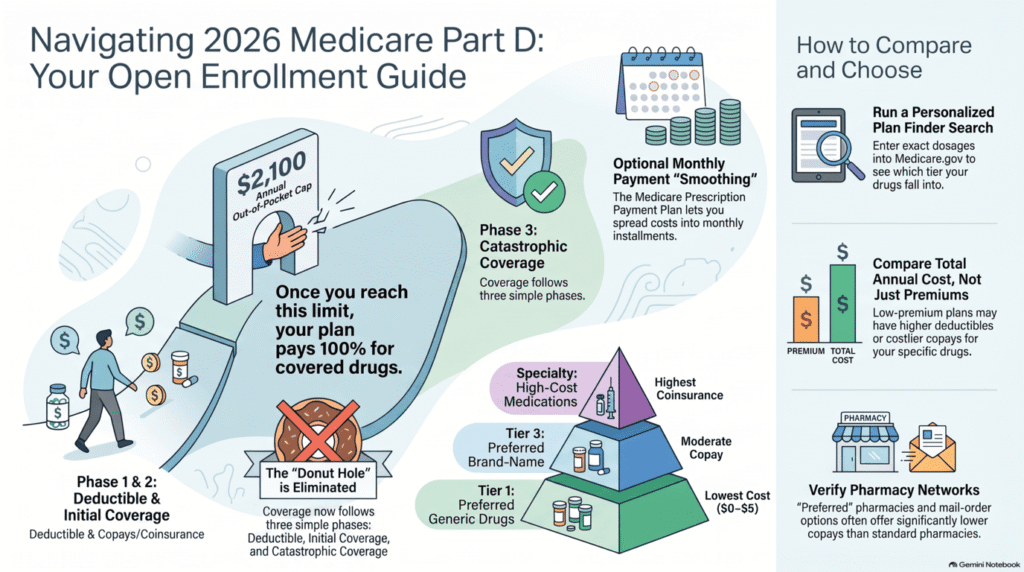
Following changes from the Inflation Reduction Act, the Part D “donut hole” coverage gap that used to exist has been eliminated, replaced with a simpler three-phase structure and a hard annual cap on out-of-pocket spending:
| Phase | How It Works |
|---|---|
| Deductible | You pay 100% of drug costs up to your plan’s deductible (2026 maximum: $615, though many plans set a lower or $0 deductible) |
| Initial coverage | You pay a copay or coinsurance for each covered drug based on its tier |
| Catastrophic coverage | Once your total out-of-pocket spending on covered drugs reaches $2,100 (2026), your plan pays 100% of covered drug costs for the rest of the calendar year |
CMS is expected to announce final 2027 figures in the fall, closer to the start of AEP — check Medicare Costs in 2027: Premiums, Deductibles, and Limits for the most current confirmed numbers.
New in recent years: The Medicare Prescription Payment Plan (sometimes called “smoothing”) lets you spread your out-of-pocket drug costs into monthly installments across the year instead of paying larger amounts upfront at the pharmacy. It’s voluntary, doesn’t reduce your total costs, and can be requested through your plan.
Want to see exactly which tier your medications fall into? Compare Part D plans in your area with your prescriptions pre-loaded.
Standalone Part D vs. Medicare Advantage Drug Coverage
| Standalone Part D (PDP) | Medicare Advantage with Drug Coverage (MAPD) | |
|---|---|---|
| Who it’s for | People with Original Medicare | People enrolled in a Medicare Advantage plan |
| Combined with medical coverage? | No—separate from Part A/B | Yes—bundled into one plan |
| Formulary and pharmacy network | Varies by standalone plan | Varies by the Advantage plan |
| Can I switch drug plans separately from medical coverage? | Yes | No—switching drug coverage typically means switching the whole Advantage plan |
For the broader medical coverage decision this connects to, see Medicare Advantage vs. Original Medicare: How to Decide.
How to Compare Part D Plans
- List every medication you take, including dosage and frequency—even drugs you take occasionally.
- Use Medicare.gov’s Plan Finder and enter each drug exactly as prescribed. The tool will show which tier each drug falls into for every plan in your area.
- Check your preferred pharmacy — many plans offer lower copays at “preferred” pharmacies within their network versus standard in-network pharmacies.
- Compare total estimated annual cost, not premium alone. A $0-premium plan with a high deductible and high-tier copays can cost more overall than a plan with a modest monthly premium.
- Check the plan’s star rating for member satisfaction and pharmacy service quality — see Medicare Advantage Star Ratings Explained.
Understanding Drug Tiers
| Typical Tier | What’s Included | Typical Cost |
|---|---|---|
| Tier 1 | Preferred generic drugs | Lowest copay, often $0–$5 |
| Tier 2 | Generic drugs | Low copay |
| Tier 3 | Preferred brand-name drugs | Moderate copay |
| Tier 4 | Non-preferred brand-name drugs | Higher copay or coinsurance |
| Specialty tier | High-cost specialty medications | Highest coinsurance, subject to the annual out-of-pocket cap |
The same drug can sit on a different tier from one plan to the next, which is why entering your exact medications into Plan Finder matters more than comparing plans by premium or general reputation alone.
Prior Authorization, Step Therapy, and Quantity Limits
Some drugs on a plan’s formulary require extra steps before they’re covered at the listed price:
- Prior authorization: Your doctor must confirm medical necessity with the plan before it’s covered
- Step therapy: You may need to try a lower-cost drug first before the plan covers a more expensive alternative
- Quantity limits: The plan may cap how much of a drug is covered per month
These restrictions are listed in the plan’s formulary documentation and are worth checking for any medication you take regularly, since they can delay a prescription refill if you’re not expecting them.
A plan with prior authorization on your drug can slow down refills. See which local plans cover your medications with the fewest restrictions.
Extra Help and Low-Income Subsidies
If your income and resources fall below certain thresholds, the Extra Help program (also called the Low-Income Subsidy) can significantly reduce or eliminate your Part D premium, deductible, and copays. You can apply through the Social Security Administration at any time of year—it isn’t limited to Open Enrollment. If you think you might qualify, it’s worth checking regardless of where you are in the enrollment calendar.
Late Enrollment Penalty
If you go 63 or more consecutive days without Part D or other creditable prescription drug coverage after your Initial Enrollment Period, you may owe a permanent late enrollment penalty added to your Part D premium for as long as you have Medicare drug coverage. For the full penalty calculation and how to avoid it, see Medicare Open Enrollment Deadlines and Penalties.
When to Switch Part D Plans
- A medication you take moved to a higher tier or was dropped from the formulary
- Your premium or deductible increased significantly in the Annual Notice of Change letter
- Your preferred pharmacy is no longer in the plan’s preferred network
- A new medication was prescribed that isn’t well covered by your current plan
- You started taking fewer medications, and a lower-premium plan now makes more sense
Any of these are worth a full comparison during Open Enrollment, since Part D plans can only be changed during AEP (or a qualifying Special Enrollment Period) unless you’re also switching Medicare Advantage plans during the January–March window.
The Medicare Prescription Payment Plan, Explained Further
Introduced as part of recent Part D reforms, the Medicare Prescription Payment Plan allows anyone with Part D coverage to spread their out-of-pocket prescription costs evenly across the calendar year rather than paying larger amounts at the pharmacy counter, especially early in the year before a deductible is met. For example, someone who hits a $500 out-of-pocket cost in February could instead pay it off in smaller monthly installments through the rest of the year. It’s entirely optional, doesn’t change your total drug costs, and doesn’t affect your plan’s formulary or tier structure—it only changes the timing of payments. You can opt in by contacting your plan directly, and you can opt out at any point if it’s no longer useful to you.
How Formularies Get Updated Mid-Year
While a plan generally can’t remove a covered drug from its formulary or move it to a higher tier mid-year without proper notice, formularies aren’t entirely frozen. Plans can add new generic drugs at any time, and in specific circumstances—like a drug being pulled from the market for safety reasons—a formulary change can happen outside the normal annual cycle. If your plan does make a mid-year change that affects a drug you’re taking, you’re entitled to advance written notice, and you can request a formulary exception from your plan or discuss alternative medications with your doctor.
Comparing Mail-Order vs. Retail Pharmacy Costs
Many Part D plans offer lower copays for a 90-day supply through mail-order pharmacy compared to filling the same prescription monthly at a retail pharmacy. If you take a stable, long-term medication, checking your plan’s mail-order pricing during your Open Enrollment comparison can meaningfully lower your annual drug spending without changing plans at all. Not every drug is eligible for mail order, particularly certain controlled substances, so it’s worth confirming eligibility for your specific medications.
A Simple Part D Review Checklist
- Pull an updated list of every medication, dosage, and frequency
- Read your plan’s Annual Notice of Change letter for formulary and pricing changes
- Run your medication list through Medicare.gov’s Plan Finder
- Compare at least two to three plans on total estimated annual cost
- Check whether your preferred pharmacy is in each plan’s preferred network
- Look up each plan’s star rating
- Ask about mail-order pricing for any long-term maintenance medications
- Submit any change before December 7
Why This Review Matters More for Part D Than Almost Anything Else
Of all the moving pieces in a Medicare plan, drug formularies change the most from year to year, because drug pricing itself shifts constantly and insurers renegotiate manufacturer rebates annually. A plan that was the cheapest option for your medications this year can easily become one of the more expensive options next year purely because of formulary tier reshuffling—with no change in your health or your prescriptions at all. That’s precisely why a fresh Plan Finder search every fall, rather than relying on memory of what worked last year, is worth the twenty minutes it takes.
Frequently Asked Questions
What is the Medicare Part D out-of-pocket cap for 2026?
The 2026 Part D out-of-pocket cap is $2,100. Once your out-of-pocket spending on covered drugs reaches that amount in a calendar year, your plan pays 100% of covered drug costs for the rest of the year.
Can I have Part D coverage without Medicare Advantage?
Yes. You can enroll in a standalone Part D Prescription Drug Plan (PDP) alongside Original Medicare. If you have Medicare Advantage, drug coverage is typically bundled into the plan (MAPD) rather than purchased separately.
Is the Medicare donut hole still a thing?
No. The Part D coverage gap, commonly called the donut hole, was eliminated starting in 2025 as part of Inflation Reduction Act changes. Part D now has a simpler three-phase structure: deductible, initial coverage, and catastrophic coverage with a hard annual out-of-pocket cap.
What happens if my drug isn’t on my plan’s formulary?
If a medication isn’t covered, you can ask your plan for a formulary exception, switch to an alternative drug your doctor approves, or compare other Part D plans during Open Enrollment that do cover it.
Can I switch Part D plans every year?
Yes. You can switch standalone Part D plans or switch Medicare Advantage plans with different drug coverage during the Annual Enrollment Period each fall (Oct 15 – Dec 7) or during a qualifying Special Enrollment Period.
More in This Medicare Open Enrollment Guide
- Medicare Open Enrollment 2027: The Complete Guide
- Medicare Advantage vs. Original Medicare: How to Decide
- How to Switch Medicare Advantage Plans During Open Enrollment
- Medicare Part D Open Enrollment: Comparing Drug Plans
- Medigap vs. Medicare Advantage: Which Costs Less?
- Medicare Open Enrollment Deadlines and Penalties
- Medicare Advantage Star Ratings Explained
- Medicare Special Enrollment Periods: Do You Qualify?
- Medicare Costs in 2027: Premiums, Deductibles, and Limits
- Medicare Open Enrollment Checklist: 10 Questions to Ask
Not sure your current plan is still your best option?
Compare Medicare Advantage, Part D, and Medigap plans available in your ZIP code before the December 7 deadline.
SeniorAffair.com may earn a commission from partner links above. This does not affect our editorial coverage.
We are not connected with or endorsed by the U.S. government or the federal Medicare program.
© 2026 SeniorAffair.com — A 55+ Lifestyle Digital Magazine.
Information on this page is general in nature and not a substitute for personalized advice from Medicare.gov, 1-800-MEDICARE, or a licensed insurance agent.